How to Make Red Wine Vinegar at Home (With or Without a Mother)
On this page
The short answer: red wine becomes vinegar when you give it plenty of air, a dark room-temperature spot and a starter, either a vinegar mother or a splash of raw (unpasteurized) vinegar. WineMaker magazine says a batch with a starter can take as little as three months, and one without a starter six months or more. You can skip the starter, but it takes longer.
If you make wine at home, you probably have a bottle that went flat, a batch that soured, or a glass nobody finished. This guide turns that wine into something useful on purpose. If your wine turned to vinegar by accident, our wine faults guide explains why; if you would rather keep it as vinegar, read on.
How Wine Turns Into Vinegar
Vinegar is wine that has gone one step further. In winemaking, yeast turns sugar into alcohol with no air needed. Vinegar making is the reverse in one respect: it needs air. That is why the vessel matters more than any ingredient.
Air is the whole trick
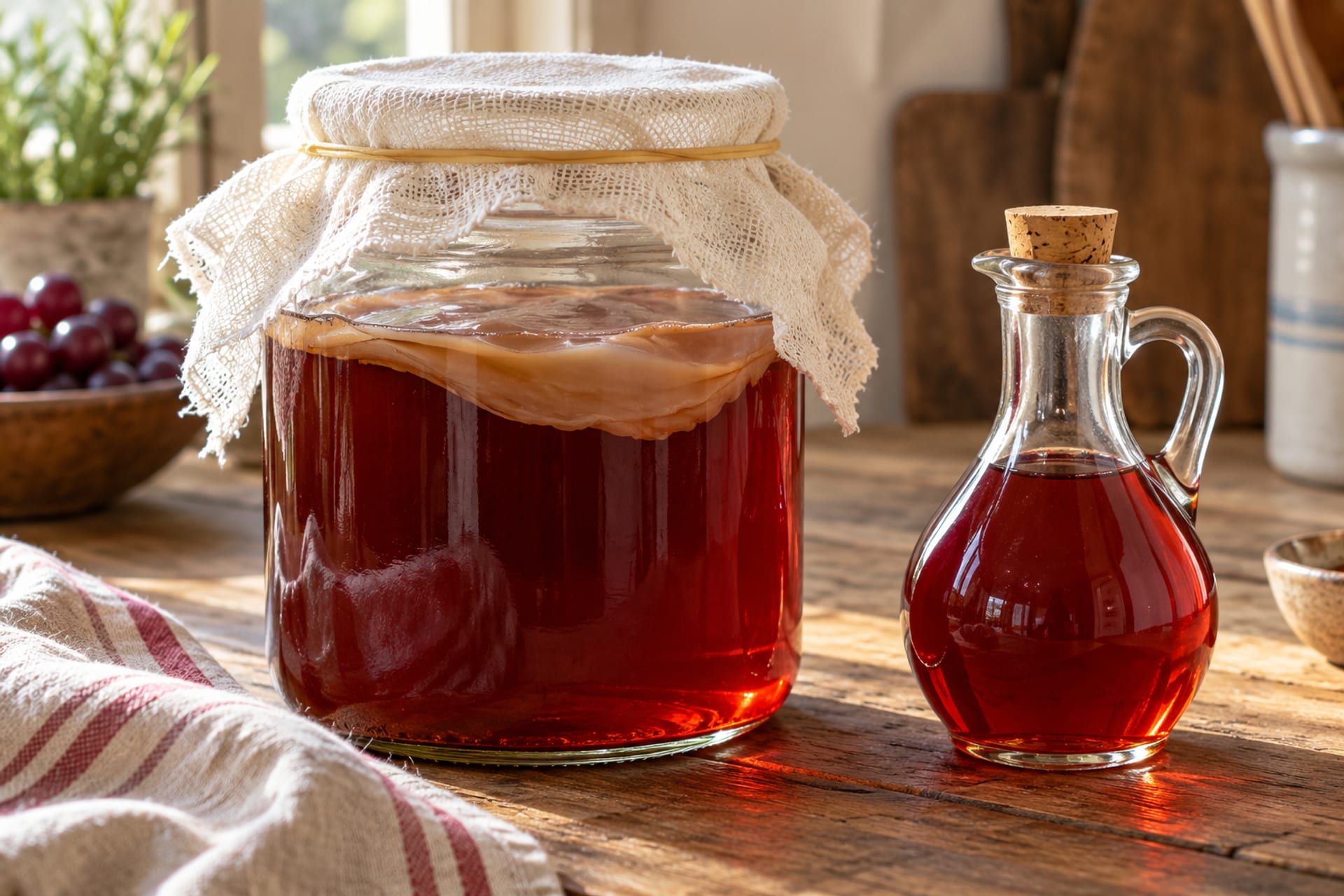
WineMaker recommends a wide-mouth jar, bowl or crock so the wine has a large surface exposed to air, covered with a few layers of cheesecloth held by a rubber band or string. The cloth lets air in and keeps fruit flies out. The article even suggests stirring the vinegar now and then to bring in more air.
The mother
The mother is the cloudy, jelly-like film that forms on the surface of a vinegar in progress. It is a sign that the process is under way. What matters for you is practical: a starter speeds things up, and it should suit the wine.
Match the mother to the wine
WineMaker's advice is to use a white wine mother for white wine and a red one for red wines. If you do not have a mother, raw vinegar that still contains the mother will do the same job.
What You Need
The list is short, and most of it is already in a kitchen or a winemaker's shed.
- A wide-mouth jar, bowl or crock big enough for your wine, so the surface area is large. WineMaker gives the example that a 750 ml bottle is about 3 1/4 cups.
- Cheesecloth in a few layers, with a rubber band or string.
- Red wine that you are happy to sacrifice. It does not have to be good, but it should not be moldy.
- A starter: about a cup of vinegar mother, or raw vinegar that contains the mother. WineMaker suggests a cup or so.
- A dark, room-temperature spot away from your winemaking area.
- Clean bottles with airtight lids for the finished vinegar.
Check the label of any bought vinegar. A pasteurized vinegar has been heated, and a starter has to be alive to work, so look for the word raw or unpasteurized and for a visible mother. A bottled red wine vinegar mother, sold as a live liquid culture, is the other option.
Keep the vinegar away from your wine. WineMaker says never to store vinegar where you make wine, and that the fewer fruit flies you draw to your winemaking area, the better.
Step by Step: Red Wine Vinegar With a Mother
This is the method WineMaker describes, written out as a sequence.
1. Prepare the vessel
Wash the jar or crock well and let it dry. Our Star San guide covers sanitizing, but for vinegar a clean vessel is enough, since you want the bacteria that make vinegar to grow there.
2. Add the wine and the starter
Pour in the red wine and add the mother or the raw vinegar. Do not fill the vessel to the top, because the wide surface is the point.
3. Cover and store
Put a few layers of cheesecloth over the mouth and hold them in place with a rubber band or string. Set the vessel in a dark, room-temperature spot. WineMaker gives no exact temperature, and we do not either.
4. Wait and taste
Sample it from time to time. It is ready when it tastes like vinegar. With a starter, WineMaker says this can take as little as three months, so do not judge it after a week.
5. Strain and bottle
Remove any film or floating material and filter the vinegar through cheesecloth if it needs it. Store it in a clean bottle with an airtight lid. WineMaker says it should last three to six months that way. You can add some of the leftover vinegar to the next batch of wine to start again.
Without a Mother
You can make vinegar without buying a starter, and the question is common enough that it shows up in related searches. The cost is time, not quality.
What changes
Everything in the steps above stays the same: the wide mouth, the cheesecloth, the dark room-temperature spot. You leave out the mother or raw vinegar. WineMaker's estimate is six months or more, against as little as three with a starter.
Is it worth waiting
If you have a spare jar and no deadline, yes. If you want vinegar sooner, add a cup or so of raw vinegar with the mother in it, the amount WineMaker suggests for a starter. Raw vinegar from a store is a better starter than ordinary pasteurized white vinegar, which has been heated.
What about sulfites
Many home winemakers add Campden tablets to their wine, and sulfite is there to hold back microbes. We have no figure for how much it slows a vinegar mother, so treat this as a possibility rather than a rule: if a heavily sulfited wine shows no change after several weeks, try a fresh, unsulfited bottle.
How You Know It Is Done
You decide by taste and smell. WineMaker's instruction is to keep it going until it tastes like vinegar and to sample whenever you like.
Taste and smell
A sharp, clean vinegar smell with no sweetness of wine left is a good sign. If it still tastes of wine, give it more time.
What not to worry about
A cloudy film or a jelly-like layer is normal, because that is the mother. Strain it out when you bottle.
Test strips and acidity
Some people measure acidity with strips or a titration kit. We do not give a target here. The kitchen test, that it tastes and smells like vinegar, is what WineMaker uses.
If it smells bad
Fuzzy mold on the surface, or a smell of rot rather than sharp vinegar, means you should throw it out and start over with a clean vessel. Vinegar is meant to smell sour, not spoiled.
Can You Use It for Canning?
No. Use it in salad dressings, marinades and sauces, but not in canning or pickling recipes.
The reason is acidity. The National Center for Home Food Preservation recommends white distilled and cider vinegars of 5 percent acidity for pickling, and says not to use a vinegar with unknown acidity. Homemade vinegar has no label and no measured acidity, so it fails that test by definition. For canning, buy vinegar labeled 5% acidity.
From a Failed Batch: When Acetic Wine Is Worth Saving
A wine that has turned vinegary is usually a loss as a drink. As vinegar it may be fine. This is the one case where a fault becomes a result: turned to vinegar? Make it on purpose.
When it is worth it
If the wine smells sharp and sour, with no mold on top, you can pour it into a wide crock and treat it as a vinegar start. Our wine faults guide explains how an acetic wine happens and how to spot one.
When it is not
If there is mold, or the smell is rotten rather than sharp, discard it. Moldy wine is not a vinegar start.
Keep the next batch from souring
Air is what turns wine to vinegar, so tight storage and topping up matter. See how to rack wine and how long homemade wine lasts. If you are starting from scratch, our homemade wine guide is the place to begin.
Make wine responsibly, and only if you are of legal drinking age.