Refractometer Calculator
As an Amazon Associate we earn from qualifying purchases. How we choose products.
On this page
A refractometer is great for the first reading, the day you crush grapes or mix a must, but once the yeast has started working the number on the scale stops meaning what it did. Alcohol bends light too, so a reading taken mid-fermentation or at the end looks higher than the sugar really is. Enter your original Brix and your current Brix below and the calculator corrects the second one into a specific gravity and an estimated alcohol by volume (ABV).
If your must has not started fermenting, you do not need a correction: use the Brix to specific gravity converter. This page is for readings that already have alcohol in them.
Refractometer correction calculator
Leave at 1.00 for grape and fruit must. Brewing calculators often use 1.04 for beer wort.
1.092original gravity
1.002corrected gravity now
11.8%estimated ABV
Why Alcohol Throws Off a Refractometer
A refractometer does not measure sugar. It measures how much a drop of liquid bends light and converts that bend into a Brix number on the assumption that the only thing dissolved in the liquid is sugar. In unfermented juice that assumption is close enough. In fermenting wine it is wrong, because the sugar is being replaced by alcohol, and alcohol bends light as well.
Two effects pull in opposite directions
Brewer’s Friend, in its guide to using a refractometer correctly, says that alcohol throws off the refraction even more, and that the fix is to use the original gravity together with a final gravity equation from Sean Terrill’s research. The sugar disappears, so the true gravity falls, but the alcohol keeps the refractometer reading higher than it should be. If you simply convert the current Brix to gravity, you will believe the wine is sweeter than it is.
What this means for a winemaker
The error matters most when you most want an answer: near the end, when you are deciding whether the wine is dry or has stalled. A raw refractometer reading of 8 Brix on a wine that started at 22 Brix does not mean the wine still holds a lot of sugar. The worked example below shows what it does mean.
The Correction Formula
The calculator uses the cubic equation Sean Terrill published in 2011 in his post “Refractometer FG results”, which Brewer’s Friend and other brewing calculators reproduce. Both readings are first divided by the correction factor (see the next section) to give OB for the original and FB for the current Brix. The current gravity is then:
FG = 1.0000 − 0.0044993 × OB + 0.011774 × FB + 0.00027581 × OB² − 0.0012717 × FB² − 0.0000072800 × OB³ + 0.000063293 × FB³
Where the other numbers come from
The original gravity is the ordinary Brix to gravity conversion applied to OB, the same one used by our Brix converter. Alcohol is then estimated with the standard formula, ABV = (OG − FG) × 131.25, as in our wine ABV calculator.
Know its limits
Terrill built the equation from refractometer and hydrometer readings of beer, not wine. Treat the result as a good estimate, not a measurement. Before you stabilize or bottle, confirm the final gravity with a hydrometer (the hydrometer calculator corrects that reading for temperature). The formula also only makes sense when the current Brix is lower than the original; if it is equal or higher, the calculator reports no fermentation instead of a number.
Correction Factor: When to Use 1.00 or 1.04
Brewer’s Friend explains that a refractometer reading of wort has to be divided by a “wort correction factor” that belongs to your instrument. Brewing calculators commonly default that factor to 1.04 for beer wort, to allow for the proteins and other compounds in wort. This calculator defaults to 1.00, meaning no adjustment, which is the right starting point for grape and fruit must. Change it only after you have calibrated your own instrument.
Step 1: zero it with water
Brewer’s Friend says a refractometer must be calibrated with water to read zero, and that this may be necessary before each use. Put a drop of water on the prism, close the cover, and adjust the screw until the line sits on 0.
Step 2: compare against a hydrometer
Take a refractometer reading and a hydrometer reading of the same unfermented must at the same temperature. Convert the hydrometer reading to Brix, and divide the refractometer figure by the hydrometer figure. That ratio is your correction factor. Enter it in the calculator and it will be applied to both readings.
Worked Example: 22 Brix Down to 8 Brix
You start a red wine at 22 Brix. A few weeks later the refractometer reads 8 Brix and you want to know where the wine stands.
| Correction factor | Original gravity | Corrected gravity now | Estimated ABV |
|---|---|---|---|
| 1.00 (default for must) | 1.092 | 1.002 | 11.8% |
| 1.04 (beer wort default) | 1.088 | 1.003 | 11.1% |
A raw conversion of 8 Brix would have suggested a gravity near 1.032, a sweet wine. The corrected figure of about 1.002 says the wine is nearly dry. The second row shows how much the factor matters: it moves the estimate by about 0.7 points of ABV, which is why you should calibrate and confirm the end point with a hydrometer. If the corrected gravity is higher than you expected, read about stuck fermentation before you add anything.
If you are still deciding when to pick, when to harvest grapes for wine covers the starting Brix to aim for.
Refractometer or Hydrometer?
Use the refractometer for the starting reading, where it needs only a few drops, and this calculator for a quick mid-fermentation check. Use a hydrometer for the final reading, because it measures density directly and alcohol does not fool it. Our guide on how to use a hydrometer covers the reading step by step.
What you need
A refractometer for the start, a hydrometer to confirm the end.
-
1Refractometer for the first reading
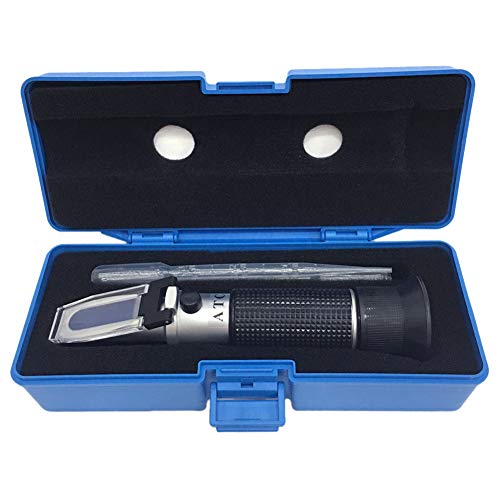
aichose Brix Refractometer with ATC, Dual Scale
Reads 0 to 32% Brix and 1.000 to 1.120 specific gravity from a few drops, with automatic temperature compensation, according to the maker.
-
2Hydrometer and test jar
Brewer's Elite Triple Scale Hydrometer and Plastic Test Jar
Reads specific gravity, potential alcohol and Brix on one stem, with a 250 ml test jar, hard case and cloth in the box, per the listing.

Related Tools and Guides
- Brix to specific gravity converter for readings before fermentation.
- Hydrometer calculator to correct a hydrometer reading for temperature.
- Wine ABV calculator from original and final gravity.
- When to harvest grapes for wine.
- All winemaking tools.
You must be of legal drinking age to make and drink wine. Enjoy it responsibly.