Skeeter Pee Recipe
As an Amazon Associate we earn from qualifying purchases. How we choose products.
On this page
The short answer: Skeeter Pee is a lemon wine made from bottled lemon juice, sugar, water and the yeast sediment (slurry) left behind when you rack another wine. For 5 gallons, the original recipe uses three 32 ounce bottles of 100% lemon juice, 7 pounds of sugar made into invert syrup, ¾ teaspoon of tannin, 6 teaspoons of yeast nutrient and 2 teaspoons of yeast energizer, split into two doses, with water to about 5½ gallons. It starts at a gravity of about 1.070, ferments to about 10% alcohol, and is cleared, stabilized and sweetened with about 2⅓ pounds of sugar before bottling.
The recipe and the name come from Lon DePoppe, a Minnesota home winemaker who shared it on the WinePress.us forums and later on his own site, skeeterpee.com. Everything below follows his published recipe and his answers to readers’ questions.
Recipe card
Skeeter Pee, 5 US gallons
- Makes
- About 25 bottles (750 ml)
- Time to drink
- Ready once clear, no aging needed
- Difficulty
- Easy
Ingredients
- 3 bottles (32 oz each) 100% lemon juice, such as ReaLemon
- 7 lb (16 cups) sugar to ferment
- ¾ tsp tannin
- 6 tsp yeast nutrient (3 now, 3 later)
- 2 tsp yeast energizer (1 now, 1 later)
- About 4½ gallons water
- Yeast slurry from another wine
- ½ tsp potassium metabisulfite (K-meta)
- 2½ tsp potassium sorbate
- Sparkolloid, as the package directs
- About 2⅓ lb (6 cups) sugar to sweeten, to taste
Method
- Make invert syrup: heat the 16 cups of sugar with 8 cups of water and ⅓ cup of lemon juice just below boiling for about 30 minutes, stirring.
- Pour it into the primary with 2 bottles of lemon juice and water to 5½ gallons. Add the tannin, 3 tsp nutrient and 1 tsp energizer. Aim for a gravity of about 1.070.
- Whip hard with a wire whisk, cover with a towel and leave 24 to 48 hours.
- Whip again and pour in an active yeast slurry. Keep it at 70 to 78 °F.
- At about 1.050, whip in the remaining 3 tsp nutrient, 1 tsp energizer and the last bottle of lemon juice. Rack to a carboy a couple of days later.
- When dry (0.995 to 0.998), rack, degas, add K-meta, sorbate and Sparkolloid. After two weeks, rack, sweeten, wait two more weeks and bottle.
Recipe: Lon DePoppe, Skeeter Pee Recipe, skeeterpee.com (archived copy of December 2013).
Where This Recipe Comes From
Lon DePoppe’s original site now redirects elsewhere, but the Internet Archive kept his pages: the Skeeter Pee Recipe, a long FAQ and an About page describing him as a Minnesota winemaker who frequents the WinePress.us forums. He calls it the original, inexpensive, quick and easy hot-weather lemon thirst quencher, and in his FAQ describes it simply as a lemon wine.
As for the name: Lon wanted to set it apart from commercial hard lemonades, and it tastes best on the hot, humid Minnesota evenings when the mosquitoes are at their worst. It is also, he admits, the color most batches turn out.
Why Lemon Juice Is Hard to Ferment
Lon explains that many people struggle to get lemonade to ferment, for three reasons: the high acidity, the lack of natural nutrients, and the preservatives often added to bottled lemon juice. Every unusual step in the recipe deals with one of them.
- Invert sugar. Heating the sugar with water and a little lemon juice splits table sugar into fructose and glucose; Lon’s FAQ explains that the acid and heat do the work.
- Whipping and waiting. Beating the must with a wire whisk and leaving it 24 to 48 hours lets the preservatives in the juice dissipate, adds oxygen and brings the must to room temperature before the yeast goes in.
- Nutrient and energizer in two doses. Lemon juice has little for the yeast to live on. Lon adds half at the start and half at about 1.050, together with oxygen, to reduce the chance of a rotten egg smell, which he says lemon is more prone to because of its acidity and low nutrition.
- A big, active yeast slurry. A large, healthy yeast population copes with the acid far better than a single packet.
There is no Campden tablet at the start, and that is deliberate. Lon’s FAQ explains that bottled lemon juice is already sterile and contains sulfites, and that adding more would likely prevent fermentation.
The Yeast Slurry
The slurry is the sediment at the bottom of your primary when you rack a wine: in Lon’s words, an army of viable yeast, unused nutrients and fruit flavors that would otherwise be thrown away. He uses all of it, usually 1 to 3 cups. From fruit wines with a lot of pulp, he pours the slurry through a straining bag to hold back seeds and skins.
What makes a good slurry
- It must be alive. Lon recommends collecting it while the donor wine is still active, racking at a gravity of about 1.005.
- Avoid slurry from a wine that has already fermented dry, one pushed close to its yeast’s alcohol limit, one exposed to extreme temperatures, or one treated with sorbate or benzoate.
- Do not reuse slurry from an earlier batch of Skeeter Pee; yeast pushed to its limits is more likely to produce sulfur smells.
- Color and flavor carry over slightly. White and rosé slurries give a pale yellow drink, dark ones a pink lemonade color. Lon’s favorites are raspberry, crabapple and peach.
Starting without a slurry
You can. Lon’s FAQ gives two routes. Sprinkle yeast straight onto the must, whisk in plenty of oxygen and keep it warm, but be ready to wait up to a week for signs of fermentation. Or start a 1 gallon batch of wine from frozen concentrate, let it ferment for 5 days to a week until it is really active, and pour in the whole thing in place of the slurry. For the yeast itself, he names Red Star Premier Cuvée and Lalvin EC-1118 as reliable, robust and slower to produce sulfur aromas.
How to Make Skeeter Pee, Step by Step
Step 1: Make the invert sugar
Put 16 cups of sugar in a large stainless pot with 8 cups of water and ⅓ cup of lemon juice. Stir to dissolve, heat to just below boiling while stirring, and hold it there for about 30 minutes.
Step 2: Build the must
Let the syrup cool slightly and pour it into the primary with 2 of the 3 bottles of lemon juice. Keep the last bottle for later. Add water to make 5½ gallons, then the tannin, 3 teaspoons of nutrient and 1 teaspoon of energizer, and stir.
Step 3: Check the gravity
Lon aims for about 1.070, which makes a drink of around 10% alcohol if it ferments dry. If it is low, stir in more sugar, and make sure none is left undissolved on the bottom or the reading will be off. Our hydrometer guide shows how to read it.
Step 4: Whip and wait
Beat the must hard with a wire whisk for a couple of minutes, cover the bucket with a towel and leave it 24 to 48 hours.
Step 5: Add the slurry
Whip it once more and pour in the yeast slurry. Fermentation can take a couple of days to show; keep the must at 70 to 78 °F and whip in more oxygen if it seems slow.
Step 6: Second feeding at 1.050
When the gravity drops to about 1.050, add the other 3 teaspoons of nutrient, the second teaspoon of energizer and the last bottle of lemon juice, and mix vigorously. A couple of days later, rack into a clean carboy.
Step 7: Ferment dry, then clear
Let it ferment completely, to a gravity between 0.998 and 0.995. Rack into a clean carboy and degas it well; Lon’s FAQ says degassing is easier when the wine is warm, in the 70s °F. Add ½ teaspoon of K-meta, 2½ teaspoons of potassium sorbate and Sparkolloid as the package directs. Lon finds it crystal clear after two weeks, and notes it often clears in 30 to 45 days without fining if it is well degassed.
Step 8: Sweeten and bottle
Rack into a clean carboy, stir in about 6 cups of sugar, more or less to taste, and wait two weeks to be sure no new fermentation starts. Then bottle. It needs no aging; serve it chilled.
Can You Make 1 Gallon of Skeeter Pee?
Lon never published one. Asked for a 1 gallon recipe in his FAQ, he answered that he did not have one and encouraged readers to make the full 5 gallons. If you want to try a small batch, the table below is simply his recipe divided by five. It is our arithmetic, not a recipe he tested, so measure the gravity and treat it as a trial.
| Ingredient | Lon’s 5 gallons | One fifth |
|---|---|---|
| 100% lemon juice | 3 × 32 oz | about 19 oz |
| Sugar to ferment | 7 lb (16 cups) | about 1.4 lb (3¼ cups) |
| Tannin | ¾ tsp | about ⅛ tsp |
| Yeast nutrient | 6 tsp | about 1¼ tsp, in two doses |
| Yeast energizer | 2 tsp | about ½ tsp, in two doses |
| Starting volume | 5½ gallons | about 1.1 gallons |
| Sugar to sweeten | about 2⅓ lb (6 cups) | about ½ lb (1¼ cups), to taste |
A small batch rarely has a slurry to match, so expect to use a packet of yeast and a slower start. A 1 gallon glass jug with an airlock and a 2 gallon bucket for the primary are enough.
What you need for a 5 gallon batch
Additives and gear for Lon’s recipe. You add the bottled lemon juice, sugar and the slurry.
-
1Primary fermenter
FastRack 6.5 Gallon Fermentation Bucket with Lid
A food grade 6.5 gallon bucket with a drilled lid grommet for an airlock, room for the 5½ gallons of must plus foam.
-
2Carboy
FastRack Italian 6 Gallon Glass Carboy
A 6 gallon glass carboy for the second half of fermentation and clearing; takes a #7 stopper, sold separately.
-
3Yeast, no slurry
Red Star Premier Cuvée Wine Yeast, 10 Pack
One of the two yeasts Lon names as reliable and slower to produce sulfur aromas; the listing calls it the fastest, cleanest and most neutral in the range.
-
4Yeast, no slurry
Lalvin EC-1118 Wine Yeast (10 Pack)
The other yeast Lon recommends; Lallemand rates it to 18% alcohol and 50 to 86 °F.
-
5Yeast nutrient
The recipe uses 6 teaspoons in two doses, and a 1 lb bag covers several batches.
-
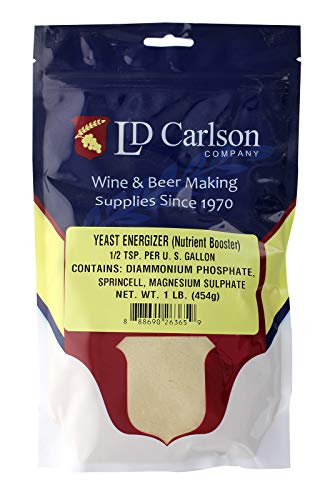
6Yeast energizer
Home Brew Ohio Yeast Energizer, 1 lb
The 2 teaspoons of energizer in the recipe, added in two doses; the listing says it helps create a complete fermentation.
-
7Wine tannin
North Mountain Supply Wine Tannin, 2 oz
The ¾ teaspoon of tannin the recipe adds at the start.
-
8K-meta
LD Carlson Potassium Metabisulfite, 1 lb
Loose K-meta powder for the ½ teaspoon added after fermentation, before sweetening.
-
9Potassium sorbate
North Mountain Supply Potassium Sorbate, 2 oz jar
The 2½ teaspoons of sorbate that stop the yeast restarting once you add the 6 cups of sugar.




Common Problems With Skeeter Pee
It will not start
Usually the preservatives in the juice or too small a yeast population. Give the must its 24 to 48 hours, whip in oxygen, keep it warm and use a large, active slurry or a 1 gallon starter.
A rotten egg smell
Lon puts this down to lemon’s high acidity and low nutrition. The second dose of nutrient and energizer at 1.050, whipped in with oxygen, is there to prevent it, and choosing yeasts such as Premier Cuvée or EC-1118 helps.
It will not clear
Degas it thoroughly while it is warm, then use Sparkolloid if you are in a hurry. Lon also finds that a cloudy batch tastes more yeasty, so clearing is worth the wait.
Using fresh lemons or frozen lemonade
People have, Lon says, with varying success: the acidity differs, frozen concentrate may contain preservatives, and fresh lemons seem to resist fermentation. Expect to babysit the batch if you go that way.
For the general method behind country wines see how to make wine from fruit, and browse the recipe collection for more. Make and drink wine responsibly, and only if you are of legal drinking age.