Step-by-step guide
How to Stop Fermentation in Wine: Three Methods and What Fails
As an Amazon Associate we earn from qualifying purchases. How we choose products.
On this page
The short answer: to stop fermentation in wine while it is still sweet, sulfite it and chill it hard at the same time, then filter it and add potassium sorbate. WineMaker magazine’s method doses sulfite to suit the wine’s pH, moves the wine to 23 to 28°F, holds it for at least 24 hours, filters out the yeast and adds ½ teaspoon of sorbate per gallon. The other reliable options are fortifying with a spirit, which is how port is made, or letting the wine ferment dry and sweetening it afterwards. Sorbate alone, sulfite alone and cold alone do not stop an active fermentation.
Stopping a fermentation on purpose is harder than it sounds. As Dawson Raspuzzi puts it in WineMaker, once fermentation begins it can be difficult to manipulate its stopping point, and in most cases you will not want to: a healthy ferment ends on its own when the sugar runs out. This guide is for the times you do want to, for an off-dry wine, a dessert wine or an aperitif. If your wine stopped on its own before you wanted it to, that is a different problem, covered in our guide to stuck fermentation.
Before You Stop It: Pick the Right Method
| Method | How it stops the yeast | Best for | Main drawback |
|---|---|---|---|
| Sulfite and cold | Sulfite inhibits the yeast, cold slows it to a halt, filtering removes it | Off-dry and sweet table wines | Needs a fridge or freezing weather, and a fine filter |
| Fortification | A spirit raises the alcohol beyond what yeast can survive | Port-style and dessert wines | The wine becomes much stronger; the timing needs planning |
| Ferment dry, then sweeten | Fermentation ends naturally; sorbate and sulfite stop a restart | Any wine, and every beginner | Sweetness comes from added sugar or juice, not from the original fruit sugar |
Whichever you choose, you need a hydrometer to know where the fermentation is. Our hydrometer guide covers the readings, and the Brix to specific gravity converter translates between the two scales.
Method 1: Sulfite and Cold
Start before you reach your target
Cooling stops a fermentation gradually, not instantly. WineMaker’s advice is to sulfite the wine and move it to a cold place when the Brix is still one or two degrees higher than you want it to finish. On a hydrometer, a degree Brix is roughly four gravity points, so if you want a wine that finishes around 1.010, start the stop at around 1.015 to 1.018. Check with the converter if you think in Brix.
How much sulfite
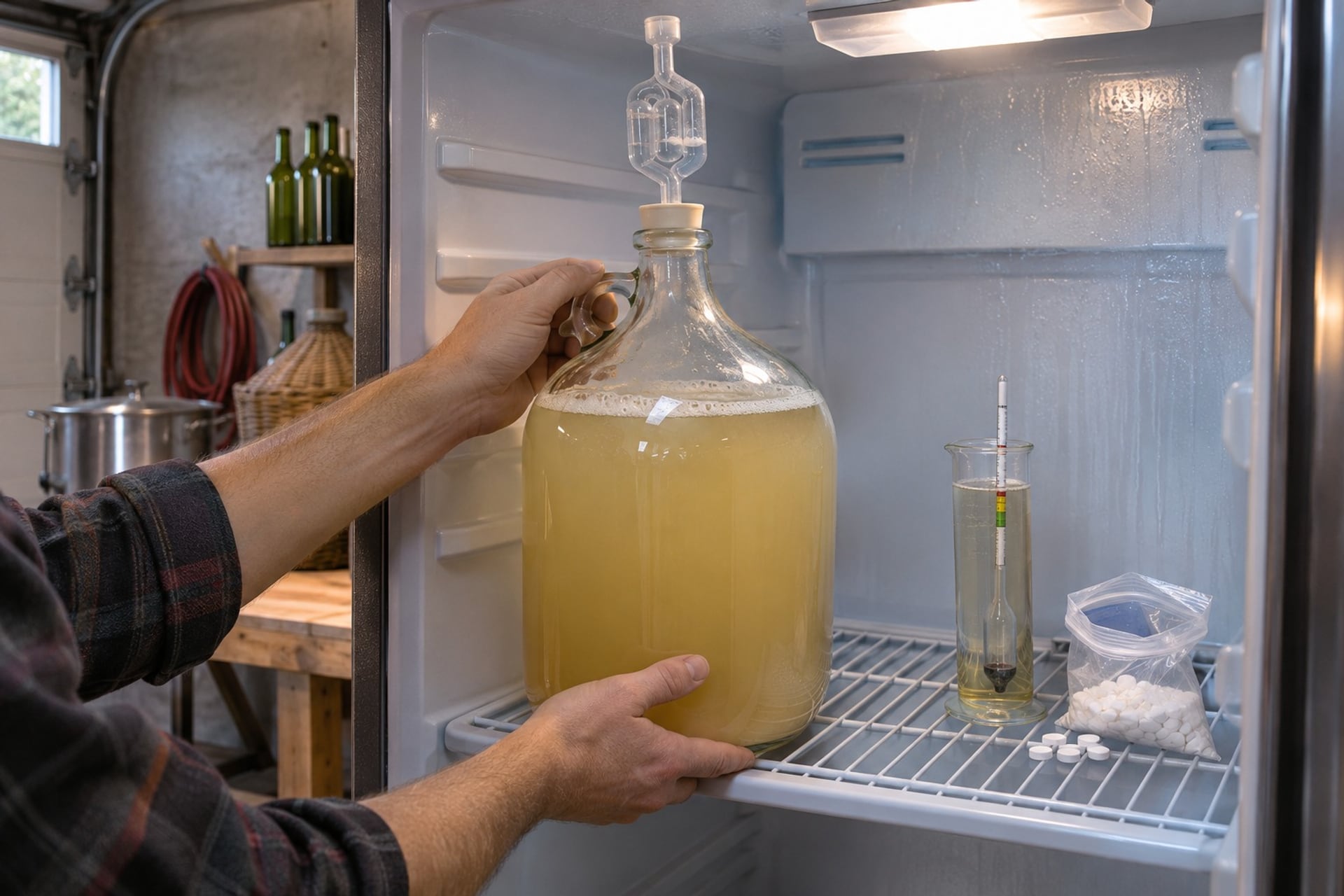
The target is 2.0 mg/L of molecular SO2, and the free SO2 needed to reach it depends on pH. WineMaker gives two examples: a wine at pH 3.2 needs 50 mg/L of free SO2 with chilling to stop fermentation, while a wine at pH 3.6 needs 125 mg/L. In practice that is 4 to 10 Campden tablets per 5 gallon batch, depending on the pH. Our sulfite calculator works out the dose for your volume and pH, and our guide to Campden tablets covers crushing and dissolving them. If you do not know your pH, a meter or test strips are worth having before you try this.
Why sulfite alone is not enough
WineMaker is direct about a common piece of misinformation: that you can simply add sulfite to stop a fermentation. The amount of sulfite it would take to stop an active fermentation at room temperature would, in almost all cases, damage the wine. The sulfite inhibits the yeast; the cold does the stopping. As the article says, you must chill the wine down once sulfited.
How cold, and for how long
Chill the wine immediately after the sulfite goes in and let it settle for at least 24 hours. WineMaker cites Daniel Pambianchi’s Techniques in Home Winemaking for the ideal range, 23 to 28°F (-5 to -2°C), and notes that temperatures up to 40°F (4°C) will also work. The warmer it is, the longer it takes. How long the stop takes overall depends on the temperature, the yeast population, the sulfite level and the alcohol content. Wine does not freeze at 32°F: WineMaker puts the freezing point of a 13% wine at about 22°F (-6°C), so a chest freezer turned up, a cold garage in winter or a spare fridge set as low as it goes are all usable. Leave room in the vessel in case it expands.
Filter, then sorbate
Cold only holds the yeast while the wine stays cold. To make the stop permanent, WineMaker’s next step is to filter the wine down to a fine grade to remove as many yeast cells as possible, then add potassium sorbate at ½ teaspoon per gallon. Rack the cold wine off its sediment first so the filter is not clogged. Our guide to the best wine filters compares home filter systems and pad grades. Sorbate does not kill yeast; it stops the survivors from reproducing, which is why it comes last, after the population has been brought down.
Method 2: Fortification
How it works
High alcohol kills yeast. WineMaker notes that strains differ, but 16 to 18 percent is usually the most they can stand. Add enough spirit to push the wine beyond that and fermentation stops fairly quickly, with whatever sugar is left still in the wine. This is the method behind port and many aperitif wines.
Plan the numbers first
Fortification is a one-way step, so do the arithmetic before you pour. Decide how sweet you want the finished wine and how strong, then time the spirit addition for when the gravity reaches that sweetness. WineMaker’s advice is to plan the desired residual sugar and alcohol in advance, and points out that if you add the spirit too late you can always add sugar afterwards. Take a reading with your hydrometer to know where you are, and use our wine ABV calculator to work out the alcohol already in the wine.
Use a commercial spirit
Use a neutral spirit or brandy you have bought. Do not distill your own: the TTB states that while adults may make wine or beer at home for personal or family use, federal law strictly prohibits individuals from producing distilled spirits at home.
Method 3: Let It Finish, Then Sweeten
For most home winemakers, the simplest way to get a sweet wine is not to stop the fermentation at all. Let it ferment dry, clear it, then stabilize it and add back the sweetness you want. Clemson Extension describes this route: potassium sorbate is the most used stabilizer for homemade wine, the wine can be back sweetened after it is added, and sugar should only ever go into stabilized wine, because sugar added to unstabilized wine can ferment again and shatter the bottle.
NDSU Extension explains what sorbate is doing here. It prevents yeast from multiplying and fermentation from restarting, and should be used if your wine has residual sugar left after fermentation or if you plan to resweeten the wine before bottling. WineMaker adds the second half: sorbate goes in with a normal sulfite dose, because sorbate without sulfite risks only stunning the yeast. The full method, with amounts and the waiting time before bottling, is in our guide to backsweetening wine.
Why this is usually the better choice
It needs no freezer, no fine filter and no pH meter, and it works the same way every time. You also control the sweetness exactly, by tasting as you add, instead of guessing at a gravity reading in the middle of an active fermentation. The trade-off is that the sweetness comes from sugar, honey or juice you add rather than from the original fruit.
What Does Not Stop Fermentation on Its Own
Potassium sorbate
Sorbate is the most common wrong answer. Northern Brewer’s product page says it plainly: potassium sorbate does not stop active fermentation, should be added only after fermentation is fully complete and the wine has been racked, and inhibits yeast reproduction, not activity. Add it to a bubbling carboy and the yeast already there will keep working.
A dose of sulfite at room temperature
As above, the sulfite needed to stop an active ferment at room temperature would harm the wine. It needs the cold alongside it.
Cold without anything else
Chilling slows yeast down, and a cold wine can look finished for weeks. Without sulfite, filtering and sorbate, the surviving yeast can pick up again as the wine warms, which is how bottles referment on a shelf. Use cold as part of Method 1, not instead of it.
Bottling it early
Bottling a wine that is still fermenting, hoping it will stop, is how bottle bombs are made. Clemson’s fact sheet warns that wine that has not been stabilized can begin to ferment again during storage and shatter the bottles. If you want a sparkling wine, that is a separate, controlled process with bottles rated for the pressure.
Plan a Sweet Finish From the Start
If you know before you start that you want to stop a fermentation short, WineMaker suggests making it easier on yourself from day one:
- Skip the yeast nutrient. A yeast population that is not fed extra nitrogen grows less vigorously.
- Consider under-pitching. Less yeast at the start means a less aggressive fermentation.
- Ferment cool. Stay at the low end of your yeast’s recommended temperature range.
A yeast with a lower alcohol tolerance helps too, since it will give up sooner on its own. Our guide to the best wine yeasts lists the tolerances of common strains. And if you are not sure whether your wine has actually finished, our guide on how long wine takes to ferment shows how to confirm it with stable readings over several days.
What you need to stop a fermentation
For Method 1 you need all five. For Method 3, sulfite, sorbate and a hydrometer are enough.
-
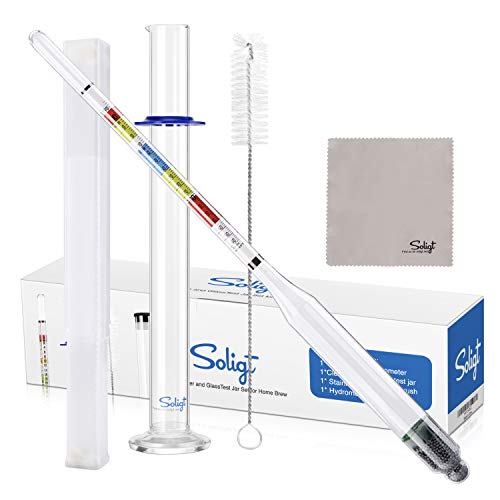
1Hydrometer
SOLIGT Triple Scale Hydrometer and Test Jar
Gravity, potential alcohol and Brix scales, so you can time the stop and confirm it held.
-
2Campden tablets
Campden Tablets (potassium metabisulfite), 1 lb
Pre-measured sulfite; WineMaker’s range for stopping is 4 to 10 tablets per 5 gallons depending on pH.
-
3Sulfite powder
Easier to dose exactly by weight for larger batches, using the sulfite calculator.
-
4Potassium sorbate
North Mountain Supply Potassium Sorbate, 2 oz
Half a teaspoon per gallon after filtering, or before backsweetening.
-
5Wine filter
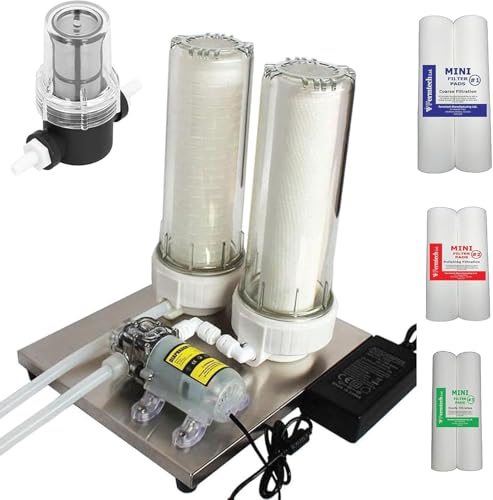
Fermtech Mini 2 Filter Starter Kit
A home filter system with pads, for taking the chilled wine down to a fine grade before the sorbate. This is the mid-range ($$) item here.


Wine is for adults of legal drinking age. Enjoy it responsibly.