Brix to Specific Gravity Converter
As an Amazon Associate we earn from qualifying purchases. How we choose products.
On this page
Grape growers and refractometers speak in degrees Brix; most hydrometers and wine recipes speak in specific gravity. Type a value into either box below and the other one updates, together with the potential alcohol the juice would reach if it fermented completely dry.
Use it on juice or must before fermentation. Once the yeast is working, alcohol skews both kinds of reading, which is explained further down.
Brix and specific gravity converter
Type in either box; the other one updates.
12.1%potential alcohol if fermented to 1.000
Is Brix the Same as Specific Gravity?
No, but they measure the same thing in two ways. Wikipedia’s Brix article defines one degree Brix as one unit of mass of dissolved solids in 100 units of mass of solution, so 22°Bx juice is roughly 22% sugar by weight. Specific gravity is the density of the liquid compared with water: pure water reads 1.000, and North Dakota State University Extension’s guide to getting started with home winemaking (FN1638) notes that must usually starts at 1.080 or higher while a finished dry wine can read as low as 0.990.
Because dissolved sugar is what makes juice denser than water, one scale converts into the other with a formula, as long as the liquid is mostly sugar and water. That is true for fresh juice and for must before fermentation.
The formulas behind the converter
The converter uses the two equations published on Brewer’s Friend’s Brix conversion calculator, which credits the first to Brew Your Own magazine and the second to the Wikipedia Brix article:
Brix to SG: SG = 1 + Brix / (258.6 − (Brix / 258.2 × 227.1))
SG to Brix: Brix = ((182.4601 × SG − 775.6821) × SG + 1262.7794) × SG − 669.5622
The two are fitted curves rather than exact inverses, so converting a number one way and back can move it by a tenth of a degree. That is well inside the error of a home hydrometer.
Potential alcohol
The third number is the alcohol the juice would reach if every gram of sugar fermented and the wine finished at 1.000, using the standard (OG − FG) × 131.25 formula from our wine ABV calculator. Real wines often finish a little below 1.000, so the true figure tends to come out slightly higher.
Brix to Specific Gravity Chart
Every row below comes from the same Brix to SG formula used in the converter, so the chart and the tool always agree. Potential alcohol assumes the wine ferments to 1.000.
| Brix (°Bx) | Specific gravity | Potential alcohol |
|---|---|---|
| 10 | 1.040 | 5.3% |
| 12 | 1.048 | 6.3% |
| 14 | 1.057 | 7.5% |
| 16 | 1.065 | 8.6% |
| 18 | 1.074 | 9.7% |
| 19 | 1.079 | 10.3% |
| 20 | 1.083 | 10.9% |
| 21 | 1.087 | 11.5% |
| 22 | 1.092 | 12.1% |
| 23 | 1.096 | 12.7% |
| 24 | 1.101 | 13.3% |
| 25 | 1.106 | 13.9% |
| 26 | 1.110 | 14.5% |
| 28 | 1.120 | 15.7% |
Specific gravity to Brix
| Specific gravity | Brix (°Bx) | What it usually means |
|---|---|---|
| 1.000 | 0.0 | Water, or a wine that has fermented dry |
| 1.020 | 5.1 | Range where NDSU suggests racking to the carboy (1.020 to 1.030) |
| 1.040 | 10.0 | Fruit juice before sugar is added, like the peach juice at 10% sugar in the University of Georgia example below |
| 1.070 | 17.1 | Low end of the starting range in Clemson’s guide |
| 1.080 | 19.3 | Typical starting point for a light wine |
| 1.090 | 21.6 | Typical starting point for a dry red |
| 1.100 | 23.8 | High end of the starting range in Clemson’s guide |
| 1.120 | 28.1 | Dessert wine or strong mead |
The starting range comes from Clemson Cooperative Extension’s basics of home winemaking fact sheet, which says wines should have an original gravity between 1.070 and 1.100, and that the higher the starting gravity, the higher the final alcohol.
When the Conversion Stops Working
After fermentation starts
The formulas assume a mix of sugar and water. Once yeast makes alcohol, both instruments drift, and in opposite directions. Wikipedia’s Brix article explains that alcohol has a higher refractive index (1.361) than water (1.333), so a refractometer reading taken on fermenting must comes out substantially higher than the real sugar content, while a hydrometer reads lower because alcohol is less dense than water. For anything after day one, read gravity with a hydrometer and use the ABV calculator rather than converting Brix.
Juice that is not just sugar
Acids, pectin and pulp also add a little to the reading. For grape and most fruit juices the error is small, but strain the sample through a cloth before you measure so pulp does not sit on the prism or around the hydrometer stem.
Temperature
Hydrometers are calibrated at a set temperature, 59°F (15°C) on older models and 68°F (20°C) on newer ones, according to Brewer’s Friend’s temperature adjustment calculator. Refractometers with automatic temperature compensation (ATC) correct themselves within their stated range; ones without ATC need the sample at room temperature. Our hydrometer guide covers reading technique in detail.
Raising the Brix of a juice
If your juice reads lower than the starting gravity you want, add sugar. NDSU Extension’s FN1638 says 11 grams of sugar per liter of must raises the gravity by about 0.004, or about one Brix. Our sugar calculator does the arithmetic for any batch size.
The University of Georgia Extension’s Winemaking at Home (C717) works in Brix and pounds instead: to bring juice up to 22% sugar it uses S = ((22 − B) ÷ 78) × W, where B is the sugar percentage of the juice and W is the weight of the juice in pounds. In its worked example, peach juice at 10% sugar and 35 pounds of juice need about 5.4 pounds of sugar.
Instruments that read Brix
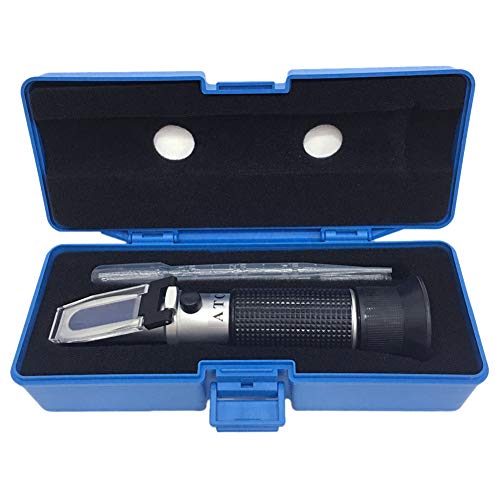
A refractometer needs only a few drops of juice, which makes it handy in the vineyard or at the market. A triple-scale hydrometer reads Brix and gravity on the same stem and also works after fermentation starts.
-
1Refractometer
aichose Brix Refractometer with ATC, Dual Scale
Shows 0 to 32% Brix and 1.000 to 1.120 specific gravity on one scale, with automatic temperature compensation, according to the maker.
-
2Triple-scale hydrometer
Brewer's Elite Triple Scale Hydrometer and Plastic Test Jar
Measures specific gravity, potential alcohol and Brix, and comes with a 250 ml test jar and a hard case, per the listing.

Related Tools and Guides
- Wine ABV calculator to turn your two gravity readings into alcohol by volume.
- Sugar calculator to reach a target Brix or gravity.
- How to use a hydrometer for wine.
- How to make homemade wine, from crushing to bottling.