Mulled Wine Recipe for Homemade Wine (and a Mulled Cider Version)
As an Amazon Associate we earn from qualifying purchases. How we choose products.
On this page
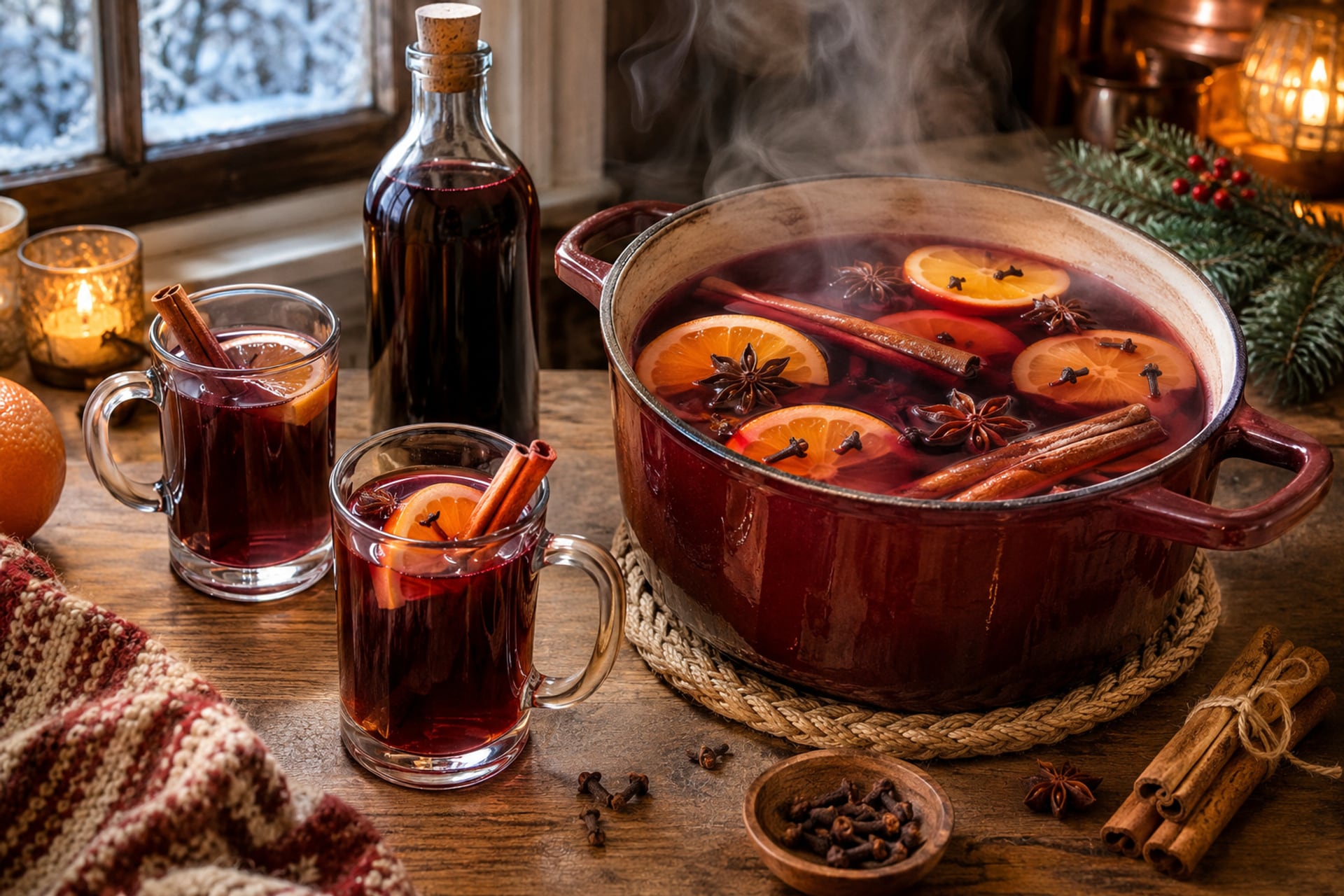
This mulled wine recipe is written for the bottles in your own cellar. Warm a bottle of fruity red with orange, cinnamon, cloves and a little honey or sugar, keep it well below a simmer for 20 to 30 minutes, and serve it in mugs. Homemade wine is ideal for it: a young elderberry, blackberry or Concord wine that is a little rough on its own becomes something people ask for again.
Below you will find the recipe for one bottle, how to scale it for a party, which homemade wines work and which do not, how hot to heat it, and what the USDA's figures say about how much alcohol stays in the pot. There is a mulled cider version too, for sweet apple cider or for your own hard cider. Every number has its source named.
Recipe card
Mulled Wine with Homemade Wine, 1 bottle
- Makes
- About 4 mugs (6 oz each)
- Time to drink
- About 35 minutes, 30 of them gently heating
- Difficulty
- Easy
Ingredients
- 1 bottle (750 ml) fruity dry or off dry red wine, homemade or bought
- 1 orange, half sliced into rounds and half juiced
- 2 cinnamon sticks
- 6 whole cloves
- 2 whole star anise
- 2 to 4 tbsp honey or sugar, to taste
- 3 oz (90 ml) brandy, optional
- Thin strip of lemon peel, optional
Method
- Pour the wine into a heavy pan. Add the orange slices, orange juice, cinnamon, cloves, star anise and 2 tablespoons of honey or sugar.
- Warm it over low heat, stirring until the honey or sugar dissolves. Bring it to a steam, with no bubbles breaking the surface.
- Hold it at that heat for 20 to 30 minutes. Do not let it boil.
- Taste it and add more honey or sugar if you want it sweeter. Stir in the brandy now, if you are using it.
- Strain into warm mugs or heatproof glasses and garnish each with an orange slice or a cinnamon stick.
A classic stovetop mulled wine method, scaled to one 750 ml bottle. Spice amounts are a starting point: taste after 20 minutes and pull the spices out when the flavor is where you want it.
Choosing a Homemade Wine for Mulled Wine
Mulled wine is forgiving, but not of everything. You want fruit and some body; the spice and sugar will cover a lot of youthful roughness.
Homemade Wines That Work
- Elderberry wine. Dark, fruity and often a little tannic when young, which is exactly what mulling likes. Our elderberry wine recipe is a good one to set aside a gallon of for winter.
- Blackberry wine. Bright fruit that stands up to cloves. See the blackberry wine recipe.
- Concord grape wine. The grapey, jammy character is close to the flavor people expect from mulled wine. See the Concord grape wine recipe.
- A kit red. A Merlot or a red blend from a wine kit works well. Save your best bottles for drinking.
- Cranberry or plum wine. Lighter, but tart and festive. Add an extra spoon of honey.
Wines to Leave Out
- A wine with a fault. Heat makes aromas louder. A wine that smells of vinegar, nail polish or rotten egg will smell worse warm. Check our wine faults guide before you mull a bottle you are not sure of.
- A heavily oaked red. Oak and cloves can turn bitter together. A light touch of oak is fine.
- Very sweet dessert wines. With honey on top, they become syrup. If your wine is already sweet, leave the sugar out and taste first.
What About White Wine?
It works, with lighter spices. In the EU rules for aromatized wine drinks, Glühwein can be made from red or white wine, but a white one has to be labeled as white. At home, try a dry apple or pear wine with a cinnamon stick, a little ginger and lemon peel instead of cloves.
How Hot to Heat Mulled Wine
Keep it steaming, never bubbling. Ethanol boils at about 173 °F (78 °C), well below water, so a pot at a rolling boil loses alcohol and aroma fast and starts to taste stewed. Aim for a pot you can see steam rising from, with no bubbles breaking the surface. If you have a thermometer, 160 to 170 °F is plenty.
Stovetop
Use a heavy pan on the lowest setting, and stir now and then so the honey does not catch. Twenty to thirty minutes is enough to draw out the spices. If it sits much longer, the cloves can turn harsh; take them out.
Slow Cooker
Good for a party. Warm the wine on high for about 30 to 45 minutes, then switch to the low or warm setting and leave the lid on. Taste after an hour and fish out the cloves and star anise if the spice gets strong.
Scaling for a Party
| Bottles (750 ml) | Mugs | Oranges | Cinnamon sticks | Cloves | Star anise | Honey or sugar |
|---|---|---|---|---|---|---|
| 1 | 4 | 1 | 2 | 6 | 2 | 2 to 4 tbsp |
| 2 | 8 | 2 | 3 | 10 | 3 | 4 to 8 tbsp |
| 4 (1 gallon is about 5) | 16 | 3 | 5 | 16 | 4 | 1/2 to 1 cup |
Spices do not scale in a straight line, so the table goes up more slowly than the wine. Taste and add more rather than starting heavy. A full gallon jug of homemade wine holds about five 750 ml bottles; our wine bottle calculator does the conversion for other volumes.
Does Mulled Wine Still Have Alcohol?
Yes, most of it. The best published figures are the alcohol retention factors in the USDA Table of Nutrient Retention Factors, Release 6. They were measured for alcohol in cooked foods, not for mulled wine, so read them as a guide:
| Method (USDA) | Alcohol retained |
|---|---|
| Stirred into a hot liquid, then removed from heat | 85% |
| Stirred in, baked or simmered 15 minutes | 40% |
| Stirred in, baked or simmered 30 minutes | 35% |
| Stirred in, baked or simmered 1 hour | 25% |
| Stirred in, baked or simmered 2 hours | 10% |
| Stirred in, baked or simmered 2.5 hours | 5% |
A mulled wine kept below a simmer and served within half an hour sits much closer to the first row than to the long simmer rows, because a covered pot that is not bubbling loses far less than a dish in an oven. Treat a mug of mulled wine like a glass of wine. If you want a mug for someone who is not drinking, make the mulled cider below with sweet cider, or mull grape juice.
Glühwein, Mulled Wine and the EU Definition
In Europe the name is regulated. Regulation (EU) No 251/2014 defines Glühwein as an aromatized wine drink obtained exclusively from red or white wine, flavored mainly with cinnamon and/or cloves, with an actual alcoholic strength of at least 7% and no added water. The same regulation defines the Nordic and Baltic versions (Viiniglögi, Vinglögg, Karštas vynas) in almost the same terms. So a true Glühwein is wine and spice, not a punch stretched with juice. Our wine ABV calculator tells you where your own bottle stands against that 7% line.
If you would rather not buy six spices
A mulling blend saves a shopping trip. All three sit in the budget tier ($); taste and adjust, because blends vary.
-
1Whole spice blend with bag
Olde Tradition Mulling Spices, 4 oz
Cinnamon, clove, allspice and orange, with a reusable muslin bag so nothing loose ends up in the mugs.
-
2Classic blend
Aspen Mulling Spices Original Blend, 5.65 oz (2 pack)
Cinnamon, clove and nutmeg in an instant mix that the maker lists for both mulled wine and spiced cider.
-
3Cinnamon forward
An instant, cinnamon forward blend; the listing says one 6 oz package flavors up to a gallon.


Mulled Cider
Mulled cider means two different drinks in the US. Most often it is sweet apple cider, the cloudy fresh pressed juice sold in the fall, heated with spices: no alcohol at all. It can also be hard cider, mulled the same way as wine. The method is the same, the spices are a little lighter, and sweet cider needs no added sugar.
Recipe card
Mulled Cider, 1 quart
- Makes
- About 4 mugs (8 oz each)
- Time to drink
- About 30 minutes, 20 of them gently heating
- Difficulty
- Easy
Ingredients
- 1 quart (about 1 liter) sweet apple cider or hard cider
- 1 orange, sliced
- 2 cinnamon sticks
- 4 whole cloves
- 4 allspice berries
- 1 thin slice fresh ginger, optional
- 1 to 2 tbsp maple syrup or brown sugar, for hard cider only
- 2 oz (60 ml) dark rum or applejack, optional
Method
- Put the cider, orange slices, cinnamon, cloves, allspice and ginger in a pan.
- Warm it over low heat until it steams, with no bubbles breaking the surface.
- Hold it there for 15 to 20 minutes, then taste. For hard cider, stir in the maple syrup or sugar now.
- Add the rum or applejack off the heat, if you are using it.
- Strain into mugs and serve with an orange slice.
Sweet cider is already sweet, so it needs no sugar. A dry homemade hard cider usually wants a little maple syrup or brown sugar to taste.
Sweet Cider, Hard Cider or Juice?
Sweet cider gives the classic result. If it is unpasteurized, the FDA notes that untreated juice and cider can carry harmful bacteria. Oregon State University Extension gives heating juice to at least 160 °F and holding it for 6 seconds as the way to pasteurize it, so check that the pot reaches that before you serve. Clear, shelf stable apple juice works too, but it tastes thinner. If you make your own, our guide on how to make cider from apples covers pressing and pasteurizing sweet cider at home.
Using Your Own Hard Cider
A dry homemade hard cider makes a sharp, clean mulled cider. Keep it below a simmer, as with wine, and add the sweetener at the end so you can taste as you go. A cider made from one of our cider making kits is a fine choice.
Storing and Reheating Leftovers
Let leftover mulled wine cool, strain out the spices so they do not keep extracting, and store it covered in the refrigerator. Reheat gently, again without boiling. It is best within two or three days, because the fruit fades and the cloves get stronger. Leftovers also make a good base for poaching pears or for a wine glaze.
Common Mulled Wine Mistakes
- Boiling it. It drives off alcohol and aroma, and the cloves turn bitter.
- Too many cloves. Six per bottle is enough. Cloves keep giving for as long as they sit in the pot.
- Ground spices. They make the wine muddy and gritty. Use whole spices or a blend in a bag.
- Sweetening first. Start with 2 tablespoons, taste after 20 minutes, then adjust. Homemade wines vary in sweetness.
- Using a faulty wine. Mulling hides roughness, not faults.
Wine is for adults of legal drinking age. Enjoy it responsibly.