Homemade wine guide
Printable Wine Labels for Homemade Wine, With a Free PDF
As an Amazon Associate we earn from qualifying purchases. How we choose products.
On this page
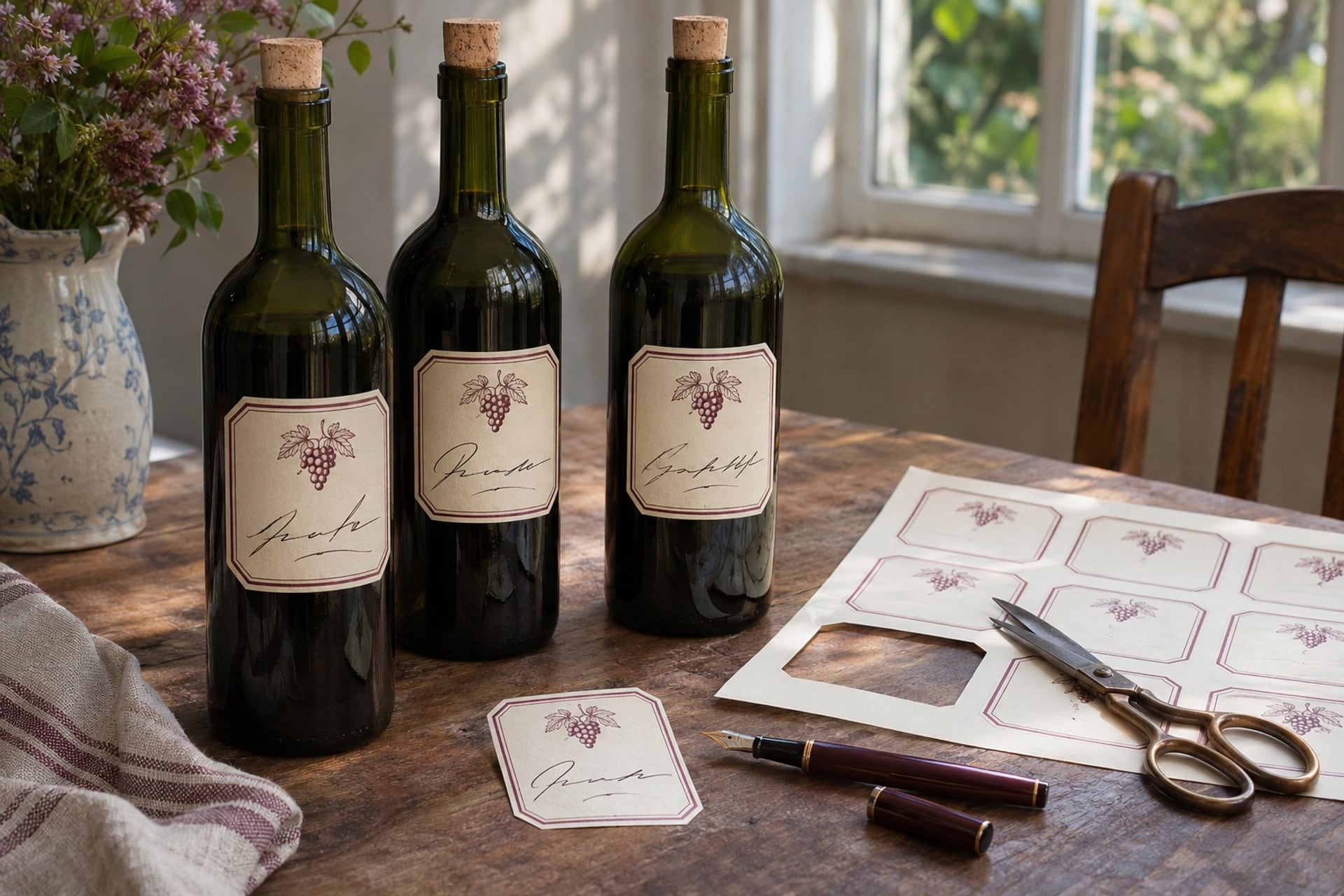
The short answer: our free printable wine labels are a two page PDF for US Letter paper. Page one has four front labels, 4 x 5 inches each, with spaces for the wine, the fruit, the style, the bottling date, the ABV and the batch number. Page two has eight smaller 4 x 2.5 inch labels: four batch notes labels for the back of the bottle and four gift labels. Print them on plain paper and glue them on, or on sticker paper, write in the details, and cut along the dashed lines.
A label is not decoration only. NDSU Extension lists personalized labels among the optional supplies for home winemaking, to carry the type of wine, the date and anything else you want to add, and notes that a bottle looks finished and more attractive with one. The practical reason is that six months from now, every bottle of white fruit wine in your rack looks the same.
Download the Free Wine Labels
Download the printable wine labels (PDF, 2 pages)
| Page | Labels | Size | Fields |
|---|---|---|---|
| 1 | 4 front labels | 4 x 5 in (10.2 x 12.7 cm) | Wine, fruit or grape, style, bottled, ABV, batch, made by |
| 2, top half | 4 batch notes labels | 4 x 2.5 in (10.2 x 6.4 cm) | Started, bottled, starting gravity, final gravity, yeast, best after, additions and notes |
| 2, bottom half | 4 gift labels | 4 x 2.5 in (10.2 x 6.4 cm) | For, from, wine, bottled, serve, drink by, a note |
The labels are designed to be filled in by hand, in pen or a fine marker, so one PDF works for every batch. Print the pages at 100% (actual size) rather than fit to page, or the labels will come out smaller than 4 x 5 inches.
What to Put on a Homemade Wine Label
The front label
The front is for the things you need to see at a glance in the rack: what the wine is, when it was bottled and how strong it is. Write the fruit or grape, and the style if it helps (dry, off-dry, sweet, sparkling). The bottling date matters most, because it tells you when a wine reaches the age its recipe calls for. Our guide on how long homemade wine lasts covers how long to keep each kind. Put the ABV from your own readings, worked out with the wine ABV calculator, rather than a guess.
The batch number
A batch number ties the bottle back to your notes. If you keep a log, give each batch a short code, like the year and a letter, and write it on both the jug and the label. When a bottle turns out brilliantly, or badly, the code takes you straight to what you did. Our free wine making log has a space for it on every page.
The back label: what went into it
The batch notes label is a short version of the log: start and bottling dates, starting and final gravity, the yeast, and the additions. Note any sulfite, sorbate, finings or sweeteners you used. It is useful to you, and to anyone you share the wine with who wants to know what is in it.
Gift labels
The gift label is for a bottle that leaves the house. Add who it is for, who made it, the wine and the bottling date, how to serve it (chilled, at cellar temperature, with a meal), and a drink by date if the wine will not keep for long.
Wine Label Sizes
Measure your bottle first
There is no single size for a wine label. What matters is the straight section of your bottle between the shoulder and the base, where a flat label can sit without wrinkling. Measure it with a ruler or a tape before you buy label sheets. A 4 x 5 inch label, portrait, is our default for a full front label; if your bottles are slimmer or have a short straight section, the 4 x 2.5 inch labels on page two can go on the front instead.
Common label sheet sizes
| Label size | Example sheet | Works for |
|---|---|---|
| 4 x 5 in | TownStix matte white, 4 labels per 8.5 x 11 sheet | Full front labels, matching our PDF size |
| 3.5 x 4.75 in | Avery 22827 product labels | A slightly smaller front label; water resistant polyester |
| 4.75 x 3.5 in, arched | Avery 22826 arched product labels | A landscape front label with a curved top, sold for wine bottles |
| 4 x 2.5 in | Our page two, on full sheet sticker paper | Back labels, neck tags cut down, gift labels |
Sticker sheets are laid out to their maker’s own template, and the positions on the sheet do not always match a PDF made for plain paper. Before printing on label stock, print the page on plain paper, hold it against a label sheet up to the light, and check that the frames sit inside the labels.
Paper, Printing and Sticking
Plain paper and glue
The cheapest option is ordinary printer paper, cut out and fixed with a glue stick or double sided tape. It looks good, peels off easily when you reuse the bottle, and suits wine that lives in your own rack. It will not survive an ice bucket.
Sticker paper
Matte sticker paper takes a pen well. The TownStix 4 x 5 inch sheets are sold as writable with pens, pencils or markers, which is what a fill-in label needs. For bottles that go in the fridge, Avery describes its 22827 labels as water resistant polyester that holds up to cold and damp conditions, with a removable adhesive that peels away cleanly. That combination suits homemade wine, because you will want the bottle back.
Keep the ink from running
Inkjet ink and some pens smudge when a cold bottle sweats. NDSU Extension’s tip is to lightly spray a fixative, such as hair spray or a clear acrylic gloss, over the label to keep the ink from fading and blurring. Let the ink dry fully first, and spray the label before you stick it on, not on the bottle.
Apply to a clean, dry bottle
Stick labels on after the bottle is filled, corked and wiped dry, at room temperature. A label put on a cold, damp bottle will lift at the corners. Press from the middle out to push the air out.
Getting Old Labels Off Reused Bottles
Most home winemakers reuse bottles, and the old label has to come off first. NDSU Extension’s method is to soak recycled bottles in hot, soapy water to soften the labels. Some will soak off readily, others can be peeled once the glue gets hot enough, and the tough ones need scraping with a razor. If glue stays on the glass after the soak, a thin coating of cooking oil softens it so it can be scraped off. NDSU also offers a shortcut: use large labels that cover the original labels. A 4 x 5 inch label covers most front labels.
Clean and sanitize the bottles before filling, as for any batch. Our guide on how to bottle and cork wine covers the whole bottling day, and if you are buying new bottles, our guide to wine bottles for homemade wine compares the common types.
Homemade Wine Labels and the Law
A label does not turn homemade wine into a product you can sell. Under the federal rule for wine for personal or family use, 27 CFR 24.75, any adult may produce wine without payment of tax for personal or family use and not for sale, up to 200 gallons a year in a household with two or more adults, or 100 gallons with one. Sharing a labeled bottle as a gift fits that rule. Selling it does not; that needs a bonded winery and the labeling rules that come with it.
For the same reason, avoid labels that copy a commercial winery’s name, logo or trade dress. Your label should say what the wine is, who made it and when.
Designing Your Own Wine Label
Start from a template
If you want a printed name rather than handwriting, open our PDF in any PDF editor that can add text boxes and type over the blank lines, or use the free templates label makers publish for their own sheets. Avery’s listings point to the templates and designs on the Avery site for its product labels, and TownStix offers print templates in PDF and Microsoft Word formats for its 4 x 5 inch sheets.
Keep it legible
A wine label is read across a room or at the back of a rack. Make the wine name the biggest thing on it, keep the date and ABV in the same place on every label, and use one or two colors. Dark ink on a light label stays readable in a dim cellar.
Add a picture
A photo of the fruit, the garden or the people who picked it makes a gift bottle personal. Print it on the label stock before you write on the details, and leave the lower half clear for the fields.
Label sheets for homemade wine
All three are in the budget tier ($). Test on plain paper first, since each sheet follows its maker’s own template.
-
1Best match for our PDF
TownStix 4 x 5 inch Matte White Labels, 30 sheets
Four 4 x 5 inch labels per Letter sheet, the size of our front labels, with a matte surface you can write on in pen.
-
2Best for chilled bottles
Avery 22827 Product Labels, 3.5 x 4.75 inch
The listing describes water resistant polyester for cold and damp conditions and a removable adhesive that peels away cleanly.
-
3Best for a classic shape
Avery 22826 Arched Product Labels, 4.75 x 3.5 inch
An arched, textured label sold for wine bottles, with a permanent adhesive for bottles that are given away.


