Free Wine Making Log and Batch Checklist
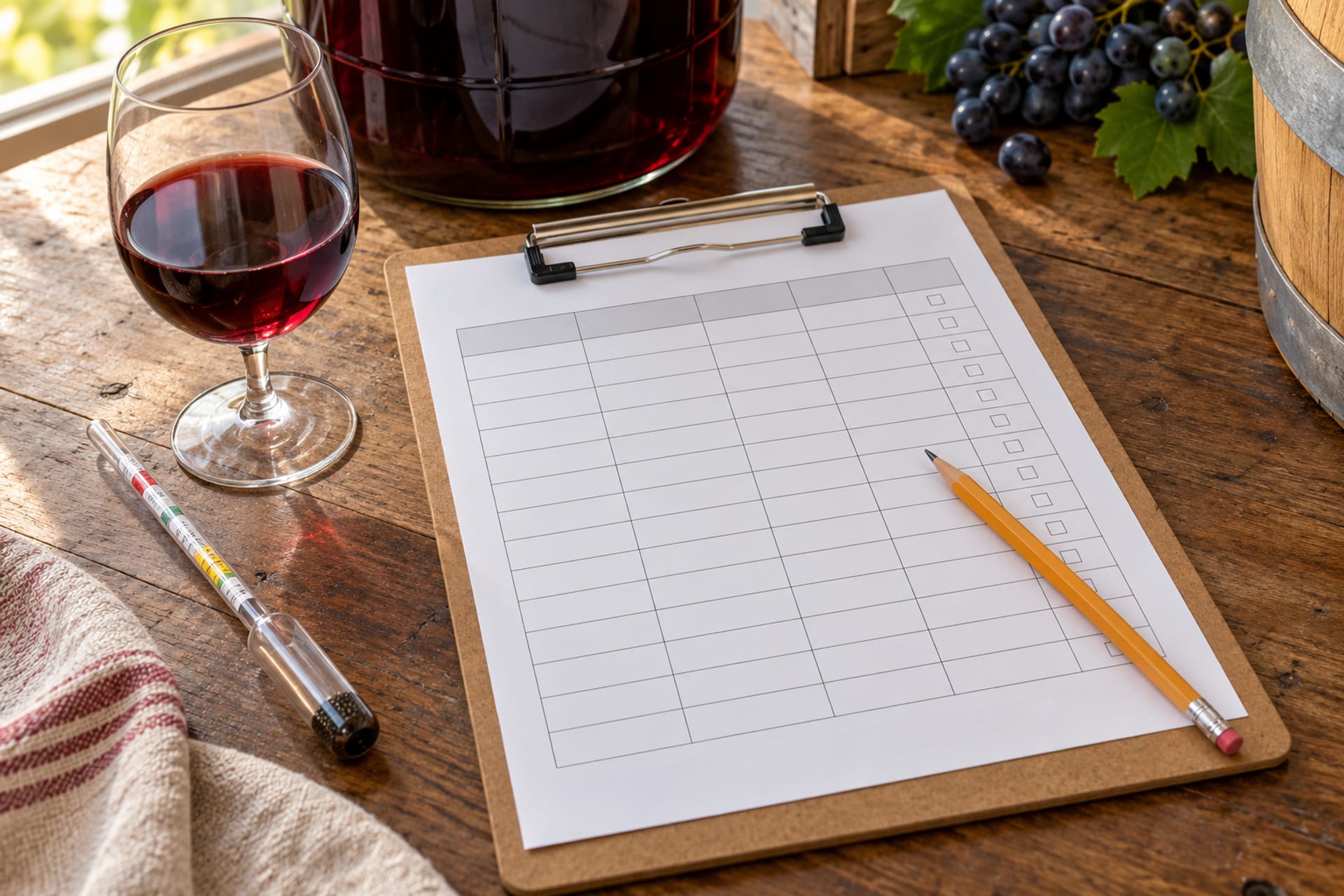
This is a free, two-page printable for home winemakers: a batch checklist that walks you through ten stages, from sanitizing to bottling, and a wine making log where you write down every reading and decision. Print it on US Letter paper, in black and white, and keep one copy per batch. Enter your email below and we will send you the PDF.
What’s in the Log
Page 1: the batch checklist
Ten boxed stages, each with short tick-box steps: sanitize, must, OG, pitch, primary, rack, secondary, clear, stabilize and bottle. It does not give amounts, because those belong to your recipe or kit. It reminds you what to do, in order, so a step is not skipped when the batch has been in the corner for a month.
Page 2: the batch log
One page for the whole batch:
- Batch details: name, start date, fruit or juice and amount, volume, original gravity (OG) and yeast.
- Additives: Campden, pectinase and yeast nutrient, with a space for the dose, the date and notes.
- Readings: a table with date, specific gravity (SG), sample temperature in °F and notes.
- Racking: date, which vessel to which, and notes.
- Finish: final gravity (FG), the ABV worked out with (OG − FG) × 131.25, bottling date, bottles filled and tasting notes.
The ABV line uses the same formula as our wine ABV calculator, so you can check your arithmetic there.
How to Use It With a Hydrometer
Fill in the top of the log before the yeast goes in
Take the original gravity reading of the must and write it in the OG box before you pitch the yeast. It cannot be recovered afterwards, and without it you cannot work out the ABV. Our guide on how to use a hydrometer shows how to take the sample and read the stem.
Write down the sample temperature
That is why the readings table has a °F column. A warm sample reads low, and the hydrometer calculator corrects a reading for temperature when you want the exact figure.
Log every reading, then the final gravity
Add a line each time you measure. When the reading is the same on separate days, write it in the FG box and finish the ABV line. If the numbers stop falling early, the dated rows in the table help you see it, and our guide to a stuck fermentation is the next stop.
Get the PDF
Enter your email, tick the box and we will send you the log. You will also get the MyHomeWine newsletter, about once a month, and every email has an unsubscribe link.
Related Guides
- How to make homemade wine, the full step-by-step guide.
- How to use a hydrometer for accurate readings.
- Wine ABV calculator to check the figure on your log.
- How to rack wine for the racking section.
You must be of legal drinking age to make and drink wine. Enjoy it responsibly.