Step-by-step guide
How to Oak Wine at Home (Chips, Cubes and Spirals)
As an Amazon Associate we earn from qualifying purchases. How we choose products.
On this page
- Oak Chips vs Cubes vs Spirals
- How Much Oak to Add
- How Long to Leave Oak in Wine
- Toast Levels and Oak Types
- When to Add Oak to Wine
- Step by Step: How to Oak Wine in a Carboy
- Do You Need to Sanitize Oak?
- Which Wines Take Oak Best
- Common Oaking Mistakes
- Oak Products for Wine Compared
- Oak Product Reviews
- Oak Chips, Cubes or Spirals: Which to Buy?
To oak wine at home, add oak chips, cubes or spirals to the wine after fermentation, taste it every week or two, and rack the wine off the oak when the flavor is where you want it. Chips work fastest, spirals sit in the middle, and cubes are the slowest and the most forgiving. A small barrel does a similar job with more upkeep; see our guide to small oak barrels if you want one.
Below we cover how much oak to add, how long to leave it in, which toast to pick, and five oak products worth buying. We did not test them. We compared the Amazon listings with published guidance from WineMaker magazine and from the retailers MoreWine and Northern Brewer, and we name the source of each number. Those sources do not always agree, so we show the range and say where we would start.
Editor's Choice
Oak Chips Inc American Oak Cubes, Medium Toast, 1 lb
Cubes are the most forgiving way to oak a batch: they extract slowly and are easy to dose by weight. This 1 lb bag is American oak in medium toast, a sensible first choice for a red.
-
Best French oak cubes
Oak Chips Inc French Oak Cubes, Medium Toast, 1 lb
The same cube format in French oak, which WineMaker describes as slower to give up its flavor.
-
Best oak chips
Home Brew Ohio American Medium Toasted Oak Chips, 1 lb
Chips extract fastest, so they suit short contact times and quick batches.
-
Best oak spirals
Midwest Oak Spirals, American Medium Toast, 8 inch (4 pack)
Medium toast spirals for a carboy, with no bag and nothing to weigh.
-
Best heavy toast spirals
FastRack Oak Spirals, American Heavy Toast, 8 inch (2 pack)
A bolder, toastier spiral for big reds, best used in small pieces.
Oak Chips vs Cubes vs Spirals
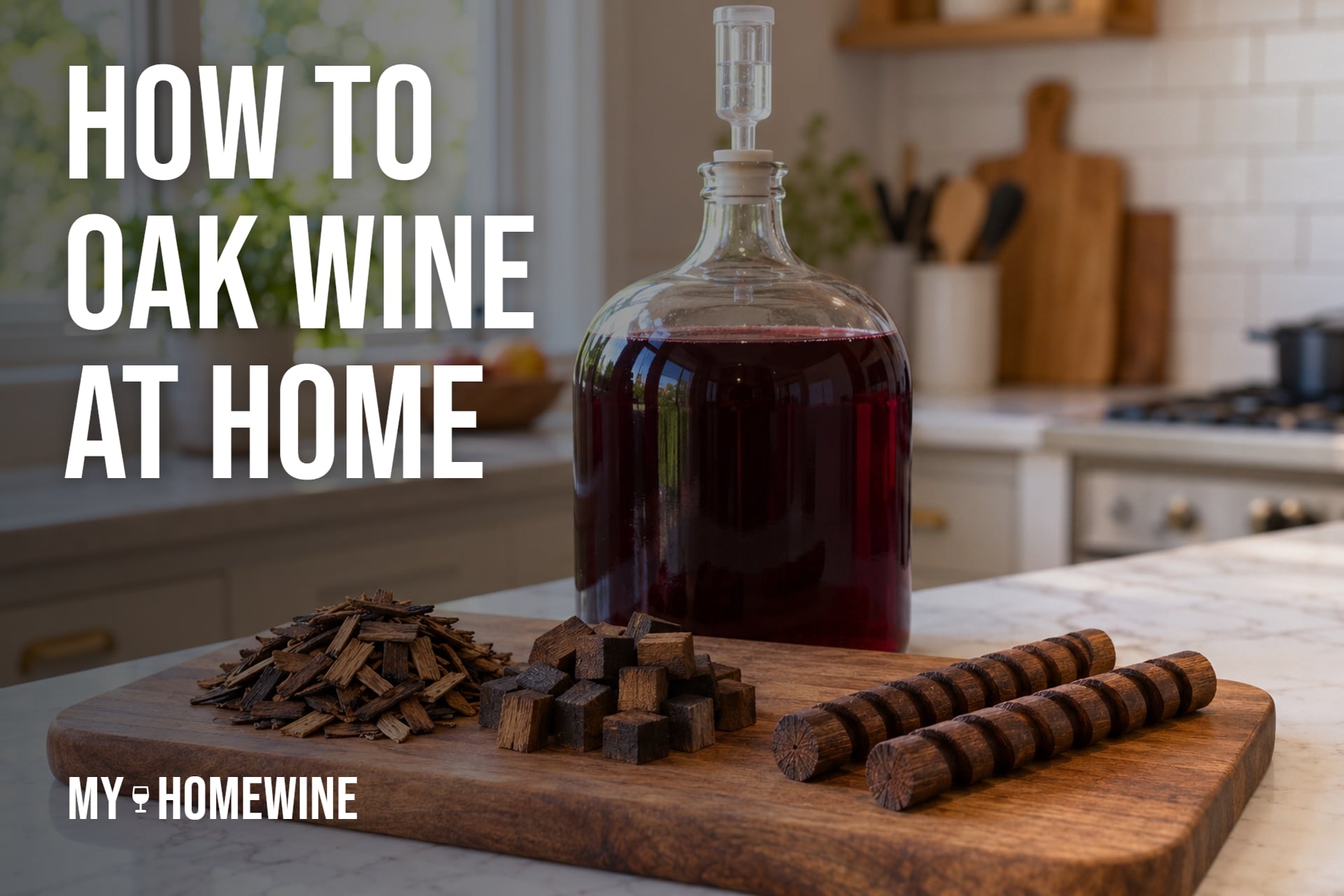
All three are the same wood cut differently, and the cut decides the speed. Tristan Johnson of MoreWine told WineMaker that chips and powders have a lot of surface area, so they extract fast, while cubes take longer and carry less risk of overoaking. Here is how the three forms compare on the published numbers.
| Chips | Cubes | Spirals | |
|---|---|---|---|
| Starting dose, 5 gallons | 3 oz (MoreWine) | 2.5 oz (MoreWine) | 1 to 2 spirals |
| Contact time | 1 to 4 weeks | 3 weeks to 12 months | 3 to 6 weeks |
| Risk of overoaking | Highest | Lowest | Medium |
| Getting it out | Lift out the bag | Rack the wine off | Rack the wine off |
| Best for | Short timelines | A first oaked wine | Carboys, no weighing |
Oak Chips
Chips are the fast option. Andrew Reudink writes in WineMaker that chips are spent within one or two weeks, and that they can go in during primary fermentation or after it. He also warns that similar quantities can have a varied effect on the wine, and that some people find a bitterness or harshness where chips were used. Use them when you want oak soon and are willing to taste often.
Oak Cubes
Cubes are chunks of toasted oak, about 1 cm across in the MoreWine listings. They give up their flavor slowly, which is why a day or two of delay in tasting will not ruin the batch. Reudink suggests saving them for secondary or beyond, and says they are easy to scale because you can count them.
Oak Spirals
A spiral is a stick of oak cut into a coil so that it exposes more wood to the wine. The ones reviewed below are 8 inches long, and they fit a carboy neck. Bob Peak writes in WineMaker that six weeks is considered long enough for full extraction with spirals, and he tells you to taste periodically to avoid overoaking. To lower the intensity, you break off a shorter length.
How Much Oak to Add
Dose oak by weight and by batch size. The table below scales MoreWine's oak guide, which gives 2.5 oz of cubes or 3 oz of chips per 5 gallons of red wine and calls that a starting point. The arithmetic for the other batch sizes is ours. For the spirals, see the note under the table.
| Batch | Cubes | Chips | 8 inch spirals |
|---|---|---|---|
| 1 gallon | 0.5 oz (14 g) | 0.6 oz (17 g) | A short piece |
| 3 gallons | 1.5 oz (43 g) | 1.8 oz (51 g) | 1 |
| 5 gallons | 2.5 oz (70 g) | 3 oz (85 g) | 1 to 2 |
| 6 gallons | 3 oz (85 g) | 3.6 oz (102 g) | 2 |
Spiral doses come from retailers: Northern Brewer suggests 2 sticks per 6 gallons and Craft a Brew says 1 spiral per 3 gallons. Bob Peak says one or two sticks are commonly recommended for a 5 to 6 gallon carboy. The two retailer figures are for medium plus toast spirals, so we would use less of a heavy toast one.
What Other Sources Suggest
The range for cubes is fairly tight. Bob Peak gives a common rate of about 2 oz in a carboy and says chip rates are about the same as cubes. Northern Brewer suggests 2.5 to 3 oz per 5 gallons. MoreWine's cube listings go wider, at 2 to 4 oz per 5 gallons. We would start at 2 oz in 5 gallons and add more later, because a second dose is easy and a first dose cannot be undone.
A Check Against Commercial Rates
Commercial rates land in the same place. The Gusmer Wine Catalog 2026-27 lists its granular Oak-Mor products at up to 360 g/hL for reds and up to 240 g/hL for whites and rosés. By our math, that is about 2.4 oz per 5 gallons for a red and about 1.6 oz for a white. Granular oak is a different cut from cubes, so read this as a sanity check rather than a dose. It does show that the homebrew figures are not timid.
Try a Small Batch First
If you are unsure, split the wine. Johnson suggests dividing a 5 gallon carboy into 1 gallon jugs and trying a different oak product in each. Dose each jug from the 1 gallon row, label it, and taste them side by side. It costs a little oak and tells you more than any table can.
How Long to Leave Oak in Wine
There is no fixed time, and the published figures are far apart. For cubes, Peak says three weeks or so is probably enough for full extraction, Reudink says it can take up to two months to reach the full depth of flavor, Northern Brewer says to leave cubes in for a minimum of two to three months, and MoreWine's guide says 3 to 12 months. Peak is talking about extraction, while the retailers are talking about contact time, so the gap is partly about what each one measures. Either way, your palate decides.
- Chips: Reudink says one or two weeks and MoreWine says 1 to 4 weeks. We would taste every few days.
- Cubes: taste after two weeks, then every week or two. Expect the flavor to keep building for a month or more.
- Spirals: Reudink says three to six weeks, and Peak and FastRack both say six weeks. Craft a Brew notes that you can pull the oak earlier for a milder result.
MoreWine's advice is the one to remember: it is better to pull the oak slightly early than slightly late.
Toast Levels and Oak Types
Toast Levels
Toast changes the flavor more than the form does. Peak says light toast gives aromas typical of the wood itself, while darker toasts bring the burnt notes of smoke and char. Between those two:
- Medium: the Home Brew Ohio listing promises vanilla and caramel, and MoreWine calls medium toast its most popular level.
- Medium plus: MoreWine lists vanilla, mocha, toffee, spice and butterscotch.
- Heavy: MoreWine lists butterscotch, caramelized sugar, clove, char and smoke, and suggests it as a small addition after your regular dose of medium or medium plus oak.
American vs French vs Hungarian Oak
Peak says American oak is usually considered fruitier than French and often shows notes of coconut. Reudink says French oak has a tighter grain and gives up flavor more slowly, that American oak leans toward baking flavors, and that Hungarian oak sits somewhere between the two. Northern Brewer reads the difference in its medium toast cubes as fresh fruit, cinnamon and allspice for French, and campfire and roasted coffee for American. Treat these as common descriptions, not measured results.
When to Add Oak to Wine
During Fermentation
You can. Peak says cubes and chips may go into primary fermentation as sacrificial tannins that help stabilize color, and Northern Brewer says its cubes can be added during fermentation or aging. The catch is control: a fermenting wine is hard to judge by taste, and you will be working around the cap and the lees.
After Fermentation
This is where we would add oak on a first batch. Reudink says cubes are best saved for secondary or beyond, and that spirals usually go in after primary fermentation. The wine is settled and you can taste what the oak is doing, which is the whole point. Oak belongs in the second stage, in a carboy kept full to the neck.
In a Wine Kit
If your kit includes oak, follow the kit's schedule first. Add more only after the wine has finished and you have tasted it.
Step by Step: How to Oak Wine in a Carboy
- Finish fermentation, then rack the wine into a clean carboy so that most of the sediment stays behind.
- Smell the oak. Discard anything moldy or musty.
- Weigh the dose. Put chips in a sanitized fine mesh bag, as MoreWine suggests. Cubes and spirals can go straight in.
- Top up the carboy to leave little headspace, and fit an airlock.
- Taste on the schedule above. Draw a small sample rather than opening the carboy for long.
- When the oak is right, rack the wine off the oak into a clean carboy.
- Continue with clearing, aging and bottling as usual.
Do You Need to Sanitize Oak?
Not new oak from a sealed bag. Reudink says these products come ready to use, with no need to prep or sterilize them. Alison Crowe, WineMaker's Wine Wizard, says she never boils or rinses her chips, because that strips their flavor and aroma. Her concern is spoiled oak: smell it before you add it, and throw out anything that smells moldy, musty or like TCA, the compound behind cork taint.
Storage matters more than sanitizing. Crowe says to use oak soon after you buy it, because an opened bag stores poorly and moisture or chlorinated water can lead to TCA and mold. Keep what is left dry and sealed. Reudink suggests freezing oak saved from a previous batch if you will not use it right away. What should be sanitized is the bag, not the wood.
Which Wines Take Oak Best
MoreWine puts it simply: a big Cabernet Sauvignon can handle more oak than a delicate Pinot Noir. Gusmer's catalog says the same at commercial scale, noting that white wines, rosé and lighter reds need minimal additions while structured, full-bodied reds can take higher levels. The Oak Chips Inc listings pitch their cubes for white wines after clarification and for red wines during malolactic fermentation.
We would treat fruit wines the same way. A dark, full wine such as elderberry can take a small dose. A light, delicate one is easily covered, so leave it alone or try a single 1 gallon test first.
Common Oaking Mistakes
- Adding the full dose at once. Start low. Mike Robustelli of McManis Family Vineyards told WineMaker to be cautious, since adding more later beats ending up with too much.
- Forgetting the chips. Chips move fast, and Johnson warns that high surface area products can overoak a wine quickly.
- Using wood from the lumber yard. Reudink says to avoid treated wood and any chemical drying agents. Buy oak sold for wine.
- Dropping cubes in the bottle. Reudink notes that they can swell slightly and become impossible to remove.
- Expecting a barrel. Oak in glass gives flavor, but not the slow oxygen exchange of wood. If you want that, see our oak barrel guide.
Oak Products for Wine Compared
Here are the five products we would pick from. Details are the ones each listing states. Speed is general to the form of the oak, not a claim from the listing. Price tiers are market tiers, and all five sit in the budget tier ($).
| Oak | Oak Chips Inc American Cubes Editor's Choice | Oak Chips Inc French Cubes | Home Brew Ohio Chips | Midwest Spirals | FastRack Spirals |
|---|---|---|---|---|---|
| Product |  |  |  |  |  |
| Form | Cubes | Cubes | Chips | Spirals | Spirals |
| Wood | American | French | American | American | American |
| Toast | Medium | Medium | Medium | Medium | Heavy |
| Size | 1 lb | 1 lb | 1 lb | 4 spirals, 8 inch | 2 spirals, 8 inch |
| Speed | Slow | Slow | Fast | Medium | Medium |
| Best for | First oaking, reds | Softer reds | Quick, short contact | Carboys, no weighing | Big reds, small pieces |
| Price tier | $ | $ | $ | $ | $ |
| Buy | Check price on Amazon | Check price on Amazon | Check price on Amazon | Check price on Amazon | Check price on Amazon |
Editor's Choice
Oak Chips Inc American Cubes
- Best for
- First oaking, reds
Show specificationsHide specifications
- Form
- Cubes
- Wood
- American
- Toast
- Medium
- Size
- 1 lb
- Speed
- Slow
- Best for
- First oaking, reds
- Price tier
- $
Oak Chips Inc French Cubes
- Best for
- Softer reds
Show specificationsHide specifications
- Form
- Cubes
- Wood
- French
- Toast
- Medium
- Size
- 1 lb
- Speed
- Slow
- Best for
- Softer reds
- Price tier
- $
Home Brew Ohio Chips
- Best for
- Quick, short contact
Show specificationsHide specifications
- Form
- Chips
- Wood
- American
- Toast
- Medium
- Size
- 1 lb
- Speed
- Fast
- Best for
- Quick, short contact
- Price tier
- $
Midwest Spirals
- Best for
- Carboys, no weighing
Show specificationsHide specifications
- Form
- Spirals
- Wood
- American
- Toast
- Medium
- Size
- 4 spirals, 8 inch
- Speed
- Medium
- Best for
- Carboys, no weighing
- Price tier
- $
FastRack Spirals
- Best for
- Big reds, small pieces
Show specificationsHide specifications
- Form
- Spirals
- Wood
- American
- Toast
- Heavy
- Size
- 2 spirals, 8 inch
- Speed
- Medium
- Best for
- Big reds, small pieces
- Price tier
- $
Oak Product Reviews
Each review sticks to what the listing and the published guidance say. The picks run from the most forgiving form to the boldest.
Oak Chips Inc American Oak Cubes, Medium Toast (Editor's Choice)
This is our first pick because cubes leave the most room for error. The listing is a 1 lb bag of American oak in medium toast, and it promises warm vanilla and subtle caramel notes. At MoreWine's 2.5 oz per 5 gallons, a 1 lb bag covers about six batches, so one bag lasts most home winemakers a long while. Use it soon after opening, as noted above.
For dosing, we rely on the published retailer figures, because the listing gives no rate. Its note for winemakers points to white wines after clarification and to reds during malolactic fermentation.
Best for: your first oaked red. Missing: a dose on the listing, and the speed of chips.
Oak Chips Inc French Oak Cubes, Medium Toast (Best French Oak Cubes)
This is the same 1 lb cube format from the same brand, in French oak. The listing promises smooth vanilla and subtle caramel notes, with a slow, steady release. That lines up with Reudink's point that French oak has a tighter grain and gives up flavor more slowly.
Choose it for a wine with delicate fruit, such as a Pinot Noir or a good Merlot kit, where the bolder American character could take over. Dose it as you would the American cubes, and give it longer before you judge it.
Best for: softer reds and subtle wines. Missing: a dose on the listing.
Home Brew Ohio American Medium Toasted Oak Chips (Best Oak Chips)
The listing is a 1 lb bag of American oak chips in medium toast, with notes of vanilla and caramel. Chips extract in days to weeks, so use them when you need oak quickly, or for a wine you plan to drink young. Taste every few days, not every week.
Put the chips in a sanitized fine mesh bag so that you can pull them out in one go. At MoreWine's 3 oz per 5 gallons, the bag covers about five batches.
Best for: quick oaking and trial batches. Missing: the slow, gradual extraction of cubes.
Midwest Oak Spirals, American Medium Toast, 4 Pack (Best Oak Spirals)
The listing is a pack of four 8 inch spirals in American oak, medium toast. It is written largely around whiskey, but it names wine and says the spirals work in glass jugs and carboys. Medium toast is why we pick this over the heavy toast pack below for most wines.
At Northern Brewer's rate of 2 sticks per 6 gallons, the pack covers two batches. For a 1 gallon jug, measure and break off a short length; Craft a Brew sells a separate small spiral for 1 gallon, which shows how little you need.
Best for: 5 and 6 gallon carboys. Missing: a dose per gallon on the listing, and French oak.
FastRack Oak Spirals, Heavy Toast, 2 Pack (Best Heavy Toast Spirals)
The listing is a pack of two 8 inch spirals in American oak, heavy toast. FastRack says the spiral uses the end grain of the wood, can go in at any stage, and has given up all its toasted oak flavor after six weeks. The listing also suggests reusing the spent spiral in a grill or smoker, which is a better idea than reusing it in wine.
Heavy toast is strong, and MoreWine treats it as a small addition rather than a main dose. In a big red we would start with part of one spiral and taste weekly.
Best for: big reds that can carry char and smoke. Missing: a dose per gallon on the listing, and a gentler toast.
Oak Chips, Cubes or Spirals: Which to Buy?
For a first batch, buy cubes, because they forgive a late tasting. If you are in a hurry, buy chips and taste often. If you have a 5 or 6 gallon carboy and do not want to weigh anything, buy spirals. A barrel gives oak flavor and slow oxygen exchange together, but it needs curing and upkeep.
Wine is for adults of legal drinking age. Enjoy it responsibly.