Wine ABV Calculator
As an Amazon Associate we earn from qualifying purchases. How we choose products.
On this page
To work out the alcohol in your homemade wine you need two hydrometer readings: the original gravity (OG), taken before you add the yeast, and the final gravity (FG), taken once fermentation has stopped. Type both into the calculator below and it returns the alcohol by volume (ABV) with the two formulas home winemakers use, plus how much of the sugar the yeast actually ate.
If you have not taken a reading yet, start with our guide on how to use a hydrometer for wine. If your hydrometer or refractometer reads in Brix, convert it first with the Brix to specific gravity converter.
Wine ABV calculator
12.3%ABV, standard formula
12.8%ABV, alternate formula (more accurate above about 1.070)
95%apparent attenuation
How to Calculate Wine ABV
Sugar makes juice denser than water. As the yeast turns that sugar into alcohol and carbon dioxide, the wine becomes less dense, because alcohol is lighter than water and the gas escapes through the airlock. The drop between your first and last gravity reading is therefore a measure of how much alcohol was made. That is why the calculator only needs two numbers, and why you cannot get a reliable ABV without the reading you took before fermentation.
The standard formula
Almost every homebrewing calculator uses the same simple equation, which Brewer’s Friend describes in its ABV calculator write-up as the formula most brewing sites use:
ABV = (OG − FG) × 131.25
It dates from before brewing software, it is easy to do on paper, and the article notes that some versions use 131 instead of 131.25, which changes the answer only slightly. For most table wines that start between 1.070 and 1.100 it is close enough for a label or a logbook.
The alternate formula for strong wines
The same Brewer’s Friend article gives a second equation that tries to stay accurate at higher starting gravities:
ABV = (76.08 × (OG − FG) / (1.775 − OG)) × (FG / 0.794)
It reports a higher figure than the standard formula as the original gravity climbs. The calculator shows both, so you can see how far apart they are for your batch. For a dessert wine, a strong fruit wine or a mead that started above about 1.100, quote the alternate figure as a range together with the standard one rather than as an exact number.
Apparent attenuation
The third result is the share of the starting gravity points that disappeared during fermentation: (OG − FG) / (OG − 1). A dry wine that finished below 1.000 shows more than 100% or close to it, because alcohol pulls the reading under the density of water. A wine that stopped at 1.010 or higher either still has sugar left or has stalled, and the number tells you which way to look.
Worked Examples
These are the readings most home winemakers see, run through both formulas. Gravity is written the way it appears on a hydrometer, so 1.090 is read as “ten-ninety”.
| Original gravity | Final gravity | Standard formula | Alternate formula | Typical case |
|---|---|---|---|---|
| 1.050 | 1.000 | 6.6% | 6.6% | Light fruit wine or hard cider |
| 1.070 | 0.996 | 9.7% | 10.0% | Lighter white or rosé |
| 1.080 | 0.995 | 11.2% | 11.7% | Dry fruit wine |
| 1.090 | 0.996 | 12.3% | 13.1% | Dry red from a kit or grapes |
| 1.100 | 0.998 | 13.4% | 14.5% | Full-bodied red |
| 1.110 | 1.000 | 14.4% | 15.8% | Strong wine or mead |
| 1.120 | 1.010 | 14.4% | 16.3% | Sweet dessert wine that stopped early |
The last row shows why both readings matter: a must that started very high but finished at 1.010 has the same standard ABV as one that started lower and fermented dry. The sweetness left in the glass is very different.
Example: a five-gallon kit red
Your kit instructions say the must should start near 1.090 and finish below 0.998. You measure 1.092 on day one and 0.995 three weeks later. The standard formula gives (1.092 − 0.995) × 131.25 = 12.7%. The alternate formula gives about 13.5%. Writing “about 13%” on the label is honest for both.
Example: a stuck fruit wine
A blackberry wine started at 1.085 and has read 1.015 for a week. The standard formula says 9.2%, and the apparent attenuation is only about 82%. The wine has stalled with sugar left. Before you bottle, read our guide to how long wine takes to ferment for the usual causes and fixes, because bottling a wine with live yeast and sugar can build pressure in the bottle.
Common Mistakes That Throw the Number Off
Skipping the first reading
Without an original gravity there is nothing to subtract from. If you forgot, the only fallback is to estimate it from your recipe: the sugar and fruit you added and the gravity they normally give. Our sugar calculator works this backwards, but treat the result as an estimate and say so on the label.
Reading a fizzy or cloudy sample
Fermenting wine is full of carbon dioxide. Bubbles cling to the hydrometer and push it up, so it reads higher than the real gravity. Spin the hydrometer gently as you drop it in, as Clemson Cooperative Extension recommends in its basics of home winemaking fact sheet, and let it settle before you read.
Ignoring temperature
Hydrometers are calibrated at one temperature, usually 59°F (15°C) on older instruments and 68°F (20°C) on newer ones, according to Brewer’s Friend’s hydrometer temperature adjustment calculator. A warm sample is less dense and reads low. Cool the sample to the calibration temperature or correct the reading before you use it here.
Using a refractometer after fermentation starts
A refractometer is ideal for the starting reading, but alcohol bends light more than water. Wikipedia’s Brix article notes that alcohol has a refractive index of 1.361 against 1.333 for water, so a refractometer reading taken once fermentation has begun comes out well above the true sugar level. Take the final reading with a hydrometer.
Calling the wine finished too early
One low reading is not the end of fermentation. Clemson’s fact sheet says most wines ferment to a final gravity of 1.005 to 0.999 and that fermentation is complete when the reading stays the same over three days. Use that steady number as your FG.
What you need to measure ABV
Two readings, one instrument for each stage. Most beginners only need the first item.
-
1Hydrometer and test jar
Brewer's Elite Triple Scale Hydrometer and Plastic Test Jar
Reads specific gravity, potential alcohol and Brix on one stem, with a 250 ml test jar, hard case and cloth in the box, per the listing.
-
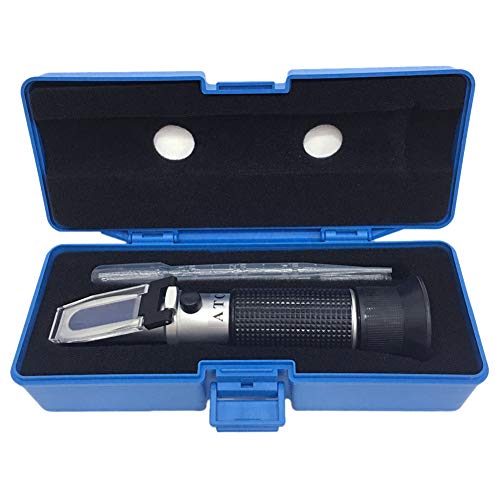
2Refractometer for the first reading
aichose Brix Refractometer with ATC, Dual Scale
Reads 0 to 32% Brix and 1.000 to 1.120 specific gravity from a few drops, with automatic temperature compensation, according to the maker. Use it before fermentation, not after.

Related Tools and Guides
- Brix to specific gravity converter for refractometer or Brix hydrometer readings.
- Sugar calculator to raise a must to the starting gravity you want.
- Sulfite calculator for the potassium metabisulfite dose before bottling.
- How to make homemade wine, the full step-by-step guide.
You must be of legal drinking age to make and drink wine. Enjoy it responsibly.