Homemade wine guide
When to Harvest Grapes for Wine
As an Amazon Associate we earn from qualifying purchases. How we choose products.
On this page
Picking day is the one decision in winemaking you cannot undo. Ohio State University Extension’s fact sheet Determining Grape Maturity and Fruit Sampling (HYG-1436) puts the dilemma plainly: once picked, grapes do not improve in flavor, color or sugar, but if they hang too long the berries can split, fall or be eaten by birds and insects. This guide covers the targets to aim for, the checks you can do in a backyard vineyard, and how to pick so the fruit reaches the crusher in good shape.
For the rest of the process, from crushing to bottling, see our guide to making homemade wine.
When Is Grape Harvest Season?
In the Northern Hemisphere most wine grapes are picked between late August and early October, according to the reference entry on wine harvest, which also notes that in the New World the harvest is often called the crush. Early varieties and warm regions come first; late-ripening varieties and grapes left for sweet wines can hang into the autumn.
The calendar only tells you when to start watching. Ohio State notes that sugar usually rises by about 1 °Brix a week as harvest approaches, so once the fruit starts to soften and change color (the stage growers call veraison) it is time to begin testing.
Harvest Targets for Wine Grapes
Three numbers describe ripeness. Brix is the sugar in the juice: 1 °Brix is about 1 gram of sugar per 100 grams of juice. Titratable acidity (TA) is how much acid the juice holds, and pH is how strong that acid is. As grapes ripen, sugar climbs while acid falls and pH rises, so the right moment is a balance rather than a single number.
| Measure | General range at harvest | Dry red wine | Dry white wine |
|---|---|---|---|
| Sugar (°Brix) | 18 to 24, depending on variety and style | About 23 to 25 | Slightly lower than reds |
| pH | 3.1 to 3.5 | 3.3 to 3.5 (OSU); 3.4 to 3.6 is the usual guideline in WineMaker | 3.1 to 3.3 |
| Titratable acidity | 0.6 to 0.8 g/100 mL | About 0.65 g/100 mL | Higher than reds |
The general ranges and the pH figures by color come from Ohio State’s HYG-1436. The red wine guideline of 23 to 25 °Brix, TA near 0.65 and pH 3.4 to 3.6 is from WineMaker magazine’s Determining Ripeness, which adds that white grapes are usually picked at slightly lower sugar, higher acid and lower pH.
Two Balance Checks
The same WineMaker article reports two rules of thumb from Linda Bisson of UC Davis for weighing sugar against acid:
- Brix × pH² = 220 to 260. Grapes at 23 °Brix and pH 3.3 give 23 × 10.89, or about 250, inside the range.
- Brix ÷ TA (in g/100 mL) = 30 to 32. At 23 °Brix and a TA of 0.75, the ratio is about 31.
Treat these as a cross-check, not a rule. Rutgers Cooperative Extension’s Wine Grape Harvest Timing Notes point out that in cool seasons sugar may peak lower while flavor still develops fully, and that varieties reach their best flavor at different sugar levels.
What the Numbers Mean for Your Wine
Sugar sets the alcohol. Enter your Brix reading in our Brix to specific gravity converter to see the potential alcohol. If the grapes come in below your target, the sugar calculator shows how much sugar raises the must to the gravity you want.
Signs Grapes Are Ready to Pick
Numbers are only half of it. Penn State Extension’s Assessing Grape Maturity for Harvest Planning describes a simple berry tasting routine, and it works as well in a backyard as in a commercial vineyard:
- Taste the juice. Crush a few berries in your mouth and judge the balance of sweetness and acidity.
- Look at the seeds. Separate them from the pulp. Green seeds are immature; brown seeds are mature.
- Check the skins. Crush the skin and notice how astringent it is. Rutgers suggests chewing the skin firmly, since astringency tracks how ripe the tannins are.
- Watch the color and texture. Berries soften and color up after veraison. Unripe fruit stays firm and sharp tasting.
Ohio State notes that the best sugar level and the best flavor do not always arrive together: one year grapes can taste fully ripe at 18 °Brix, another year they need more time. That is why the experts combine the tasting with the measurements.
How to Sample Grapes Before Harvest
One sweet berry from the sunny side of a vine says little about the whole crop. Ohio State’s sampling guidance, scaled down for a home vineyard:
- Start early. Begin at about 15 °Brix or weekly after veraison, and sample daily as harvest gets close.
- Spread the sample. Take berries from the top, middle and bottom of clusters, from both the sun and shade sides, and do not favor the best-colored berries. Skip vines at row ends and any unusual plants.
- Take enough. Penn State notes that two samples of 100 berries put you within about 1 °Brix of the real figure at harvest; ten whole clusters give the same accuracy.
- Keep the timing consistent. Sample at the same time of day each time. Ohio State found morning samples can read 1 °Brix lower than afternoon ones.
- Test promptly. Keep berries in a sealed bag in the refrigerator, or a cooler in the field, and process them within 24 hours. Crush them in the bag, strain the juice, and read it with a refractometer or a hydrometer.
For a refresher on taking gravity readings, see how to use a hydrometer.
How to Harvest Grapes for Wine
WineMaker magazine’s Preparing for Your Backyard Grape Harvest covers the practical side. The points that matter most for a small harvest:
- Pick early in the morning. Cool morning fruit has higher acid and lower Brix than fruit picked in the midday heat, and it stays in better shape until crushing.
- Remove bird netting the night before or early that morning, so it is out of the way when you start cutting.
- Use sharp shears for every picker. Wipe the blades with rubbing alcohol at the start of the day so you do not carry disease from vine to vine.
- Dress for it. Long sleeves, gloves and a hat protect against sun, scratches and wasps, which love ripe grapes.
- Sort as you go. Leave rotten, raisined or underripe clusters out of the bins, and drop rejects in the row, not under the vines, where they can spread disease.
- Keep bins clean. Sticky residue left on bins and buckets spreads mold and bacteria. Wash and sanitize everything that touches the fruit.
From Vine to Crusher
Crush the grapes the day you pick them. If you do not own a crusher, WineMaker suggests renting one from a winemaking shop or asking a local winemaking club. For a few vines, crushing by hand in a sanitized bucket works too. Our step-by-step winemaking guide takes it from there, and Campden tablets covers the sulfite dose most recipes add to fresh juice.
When the Weather Decides for You
Rain close to harvest dilutes the sugar in the berries, and wet, warm weather invites rot. Ohio State lists weather, disease and wildlife pressure among the factors that push growers to pick before every target is met. If you have to pick early, sort the fruit carefully, measure the juice, and correct the sugar with the sugar calculator rather than letting the crop spoil on the vine.
Harvest gear for a home vineyard
A refractometer for testing in the vineyard, a hydrometer for the juice, snips for picking and a crusher for the same-day crush. Clean food-grade buckets or shallow crates work as picking bins.
-
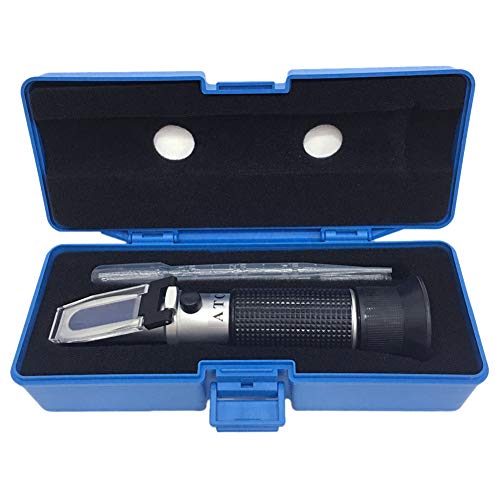
1Refractometer
aichose Brix Refractometer with ATC, Dual Scale
Reads Brix and specific gravity from a few drops of juice, with automatic temperature compensation, according to the listing. Handy for berry samples in the vineyard.
-
2Hydrometer
Brewer's Elite Hydrometer and Plastic Test Jar
Triple-scale hydrometer with test jar for reading the strained juice and, later, following the fermentation.
-
3Picking snips
VIVOSUN 6.5 Inch Hand Pruner Snips
Small stainless steel snips with micro tips and a side lock, sized for clipping grape clusters at the stem. Buy one pair per picker.
-
4Grape crusher
SQUEEZE master Grape and Berry Manual Crusher
A hand-cranked stainless steel crusher with gears designed for grapes, berries and soft fruit, 7 liters usable capacity per the listing. It crushes but does not destem, so pull the stems by hand or with a destemming screen.