Homemade wine guide
Malolactic Fermentation at Home: When to Do It and How to Test It
As an Amazon Associate we earn from qualifying purchases. How we choose products.
On this page
Malolactic fermentation (MLF) is a second, slower fermentation in which bacteria, not yeast, turn the sharp malic acid in a wine into softer lactic acid. It lowers the acidity, rounds out the taste, and makes a dry red stable enough that it will not start a fermentation of its own in the bottle. At home, you add a malolactic culture after the yeast has finished, keep the wine warm and lightly sulfited, and test until the malic acid is gone.
Most home winemakers never need it: fruit wines, sweet wines and most whites are better without it. For a dry red from fresh grapes, though, it is close to essential. This guide covers which wines to put through malolactic fermentation, when and how to add the bacteria, the conditions they need, and how to test for completion at home. The numbers come from WineMaker magazine, the bacteria maker Lallemand and the Australian Wine Research Institute (AWRI); we name each source as we go.
What Malolactic Fermentation Does
Grapes carry two main acids, tartaric and malic. Bob Peak, writing in WineMaker, explains that malic acid, named after apples, has a sharp, bright flavor and two protons that count toward the wine's acidity. When Oenococcus oeni or other lactic bacteria consume it, they release lactic acid and CO2. Lactic acid tastes softer and has only one active proton, so it contributes half as much titratable acidity, molecule for molecule. That is why MLF mellows and rounds out most red wines.
Less Acid, Higher pH
The change shows up on a pH meter. In WineMaker's tips from the pros, a winemaker describes a starting pH of around 3.1 to 3.4 that shifts upward after MLF, and treats 3.6 as the number he does not want to exceed, because above it the wine needs careful handling. If your red starts high, keep an eye on that ceiling.
Stability in the Bottle
The same article calls microbial stability the number one reason to do MLF. A dry red that still has malic acid can go through MLF on its own after bottling, and then it turns cloudy and slightly bubbly with off flavors. Doing it on purpose, in the carboy, removes the fuel before the bottle.
Flavor
Lactic bacteria can also produce diacetyl, the compound behind a buttery aroma. The AWRI notes that how much diacetyl forms depends on the bacterial strain, oxygen, citric acid and temperature. In a Chardonnay that is often welcome; in a red, strain choice matters more.
Which Wines Need Malolactic Fermentation
| Wine | MLF? | Why |
|---|---|---|
| Dry red from fresh grapes | Yes, usually | Softer acid and stability in the bottle |
| Dry red from a wine kit | Follow the kit | Kit juice is balanced and stabilized for its schedule |
| Chardonnay, Sauvignon Blanc, Pinot Gris | Optional | WineMaker says MLF can enhance some dry whites |
| Riesling, Gewürztraminer, Muscat | No | WineMaker does not recommend it for sweeter wines; it fights their fruit |
| Sweet or backsweetened wines | No | Sorbate cannot be used after MLF, and bacteria plus sugar risk volatile acidity |
| Fruit and country wines | Rarely | Their bright acid is usually the point |
| Hard cider | Sometimes | Malic is the main acid in apples, so MLF can soften a very sharp cider |
Grape Wines
WineMaker sums it up: MLF is generally used for dry red wines, can enhance some dry whites such as Chardonnay, Sauvignon Blanc and Pinot Gris, and is not recommended for sweeter wines such as Riesling, Gewürztraminer and Muscat. Climate matters too. The same article explains that grapes from cool regions such as Oregon carry more malic acid, while warm regions like California give grapes with less, so the effect of MLF is smaller there.
Kit Wines
Kits are built around their own stabilizing step. The Winexpert 4 to 8 week instructions, for example, have you add a sulphite/sorbate packet on day 14, and the schedule leaves no room for MLF. Adding bacteria to a kit and then following its stabilizing step with sorbate is the worst combination, for the reason in the warning below. If you want to try MLF on a kit red, skip the kit's sorbate packet and keep the wine dry.
Fruit Wines and Cider
Most of our fruit wine recipes rely on fresh acidity and many finish off dry, so we leave MLF out. Cider is the exception worth knowing: malic is the main acid in apples, so a very tart hard cider can soften the same way.
How to Do Malolactic Fermentation at Home
1. Choose the Bacteria
WineMaker's Bob Peak says it is more reliable to inoculate with a selected commercial strain of Oenococcus oeni than to rely on indigenous bacteria. Freeze dried cultures are sold in doses for a set volume; the Viniflora dose below treats 66 gallons, so one sachet is far more than a 5 gallon carboy needs. Check the manufacturer's instructions for how to rehydrate and how to store an opened pack. Lallemand describes its VP41 strain as tolerant of high alcohol and sulfite but a slow starter below 16 °C (61 °F), which is the kind of detail worth reading before you buy for a cold cellar.
2. Time the Inoculation
WineMaker calls waiting until the end of primary fermentation the most accepted rule of thumb. One contributor explains why: if the bacteria work while sugar is still around and the yeast have used up most of the nutrients, they can break down the sugar and create volatile acidity. Waiting also lets you check that the yeast fermentation came out clean first. Confirm the end of primary with your hydrometer; for a dry red that is around 0 °Brix or a specific gravity just under 1.000.
Some winemakers add the bacteria at the start of primary instead, a method called co-inoculation, to use the warmth of the yeast fermentation. One of WineMaker's contributors mentions it as a strategy for low pH or high acid wines. For a first batch, stick to the end of primary.
3. Keep the Sulfite Low
Malolactic bacteria do not like free SO2. WineMaker's advice is to delay the sulfite addition until MLF is complete. If you sulfited the must at crush, keep that dose modest. This is the one time in winemaking when you deliberately leave a wine unprotected, so keep the carboy full to the neck and under an airlock, and do not leave it longer than necessary.
4. Keep It Warm
WineMaker gives 60 to 75 °F (16 to 24 °C) as the range and says malolactic bacteria do not work well below 60 °F. Fresh grape wine is made in the fall, so this can be the hard part. A carboy on an inside wall, away from a cold floor, or a heating belt set low, is usually enough.
5. Watch for the Signs
Peak describes tiny bubbles of carbon dioxide rising along the walls of a carboy, and a faint crackling sound if you put your ear to it. It is much gentler than a yeast fermentation. WineMaker's other contributors say MLF should take one to three months, while Peak says it generally completes in about two to six weeks. Either way, you test rather than guess.
6. Test, Then Sulfite
When the test shows the malic acid is gone, rack the wine off any sediment, add sulfite and let it age. One of the WineMaker contributors puts it as simply as that: confirm completion, rack, add sulfite, then age. Our sulfite calculator gives the dose, and our guide on racking wine shows the transfer.
How to Test That Malolactic Fermentation Is Finished
You are not measuring the bacteria; you are measuring the malic acid they eat. Peak notes that commercial winemakers like to see malic acid below 30 mg/L (ppm) before calling a wine stable, and that for home use a value as high as 100 ppm is probably safe enough. For scale, a grape with 1.5 g/L of malic acid starts at 1,500 ppm.
Paper Chromatography
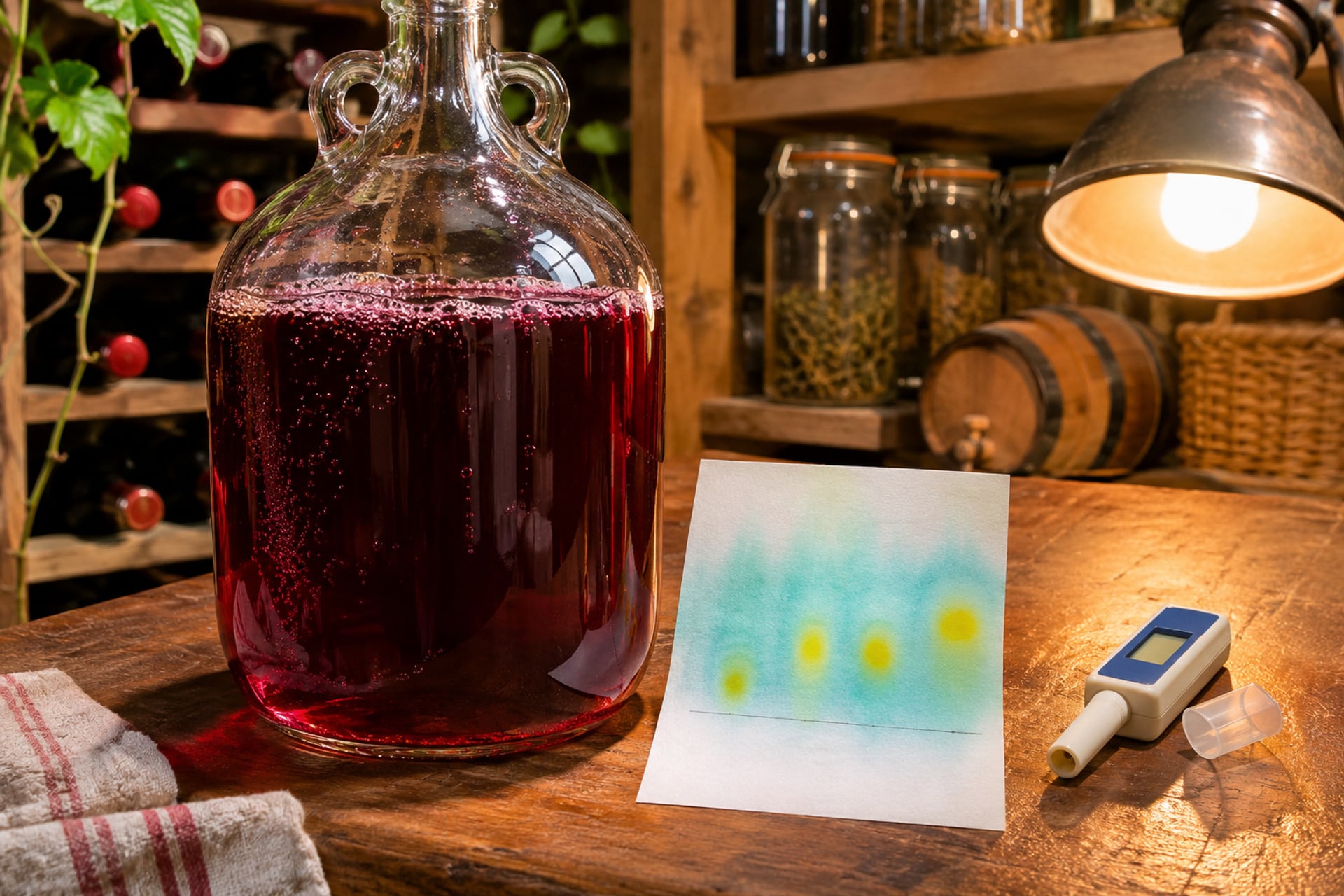
This is the classic home test. You spot drops of malic, lactic and tartaric acid standards and of each wine on a pencil line near the bottom of a sheet of chromatography paper, let them dry, and stand the paper in a jar of solvent. As the solvent climbs the paper, each acid travels a different distance. When the paper dries, the acids show as spots. If a wine shows no malic spot, its malic acid is below about 100 ppm, which Peak gives as the approximate detection limit when the spots are kept compact. Every wine shows a tartaric spot, so it doubles as a check that you spotted enough sample.
- Use pencil, not ink, for the line and labels. Ink runs with the solvent.
- Handle the paper by its edges. Peak's process is careful about contamination, and a stray fingerprint can spoil the result.
- The solvent is smelly and contains formic acid. Run it with the lid on and in a ventilated room.
- Run several wines on one sheet to save paper.
Malic Acid Test Strips
Strips are faster and need no solvent. The Accuvin kit below reads malic acid from 0 to 500 mg/L and comes with ten strips and ten samplers, and the listing says it works on red wines too. They cost more per test than paper, so they suit someone with one or two batches a year.
When to Test
Peak suggests a first test about two or three weeks after inoculating, then weekly until the malic spot disappears. Write the date and result down each time; three weeks of notes are easier to read than three weeks of memory.
What you need for malolactic fermentation
A culture, an optional nutrient, and a way to test. All three sit in the budget tier ($).
-
1Malolactic culture
Viniflora Dry Malolactic Wine Bacteria, 66 gal dose
A freeze dried malolactic culture sold as a single dose for up to 66 gallons. The listing does not name the strain, so read the packet before you buy for a cold cellar.
-
2ML nutrient
CellarScience Opti'Malo Plus, 60 g
A malolactic nutrient blend of cellulose, nutrients and yeast hulls. The listing says to mix it with a little water and add it to the wine, not to the rehydration water.
-
3Completion test
Accuvin Malic Acid Test Strip Kit, 10 Tests
Reads malic acid from 0 to 500 mg/L with no extra chemicals, so you can confirm MLF is done in minutes.


Troubleshooting a Stuck Malolactic Fermentation
WineMaker lists the conditions malolactic bacteria do not tolerate: high alcohol, high sulfur dioxide, low temperature and low pH. In practice, one of these four is almost always the cause.
Too Cold
Move the carboy somewhere warmer and give it two weeks before you test again.
pH Too Low
WineMaker says MLF generally works in reds with a pH of 3.3 or higher and whites of 3.1 or above. Measure it. Below those figures, the bacteria may never get going, and a strain sold for low pH is the better choice.
Too Much Sulfite
If you sulfited heavily at crush, the free SO2 may still be too high. There is no quick fix: wait, keep it warm, and consider a fresh dose of culture once levels have dropped.
High Alcohol
A very strong red is a harder environment. Lallemand describes VP41 as adapted to high alcohol wines, which is the kind of strain to look for.
The yeast side of the same problem, a fermentation that stops with sugar left, is covered in our guide to stuck fermentation.
Wine is for adults of legal drinking age. Enjoy it responsibly.