Banana Wine Recipe
As an Amazon Associate we earn from qualifying purchases. How we choose products.
On this page
The short answer: for one gallon of dry banana wine, mash 4½ pounds of peeled bananas with ½ pound of finely chopped banana skins, pour over 6½ pints of boiling water with 1¾ pounds of sugar dissolved in it, and let it cool. Add 12 ounces of white grape concentrate, 2 teaspoons of citric acid, ⅛ teaspoon of grape tannin, 1 teaspoon of yeast nutrient and a white wine yeast. Ferment two days on the fruit, strain into a jug under an airlock, ferment dry and give it about 90 days to clear.
That is Jack Keller’s own dry banana wine, the one he calls his favorite. Bananas are cheap all year, overripe ones are often marked down, and they make a wine with more body than most fruit wines. The catch is clarity: banana wine can stay hazy for a long time, so this page spends some time on clearing it.
Recipe card
Dry banana wine, 1 US gallon
- Makes
- About 5 bottles (750 ml)
- Time to drink
- 8 to 9 months to the first glass
- Difficulty
- Easy
Ingredients
- 4½ lb peeled ripe bananas
- ½ lb banana skins, finely chopped
- 1½ cups (12 oz) white grape juice concentrate, free of preservatives
- 1¾ lb finely granulated sugar
- 2 tsp citric acid
- ⅛ tsp grape tannin
- 6½ pints water
- 1 tsp yeast nutrient
- 1 packet white wine yeast
- Amylase enzyme, only if the wine will not clear
Method
- Mash the bananas and finely chop the skins; put both in the primary fermenter.
- Bring the water to a boil, dissolve the sugar in it, pour it over the fruit and cover.
- When cool, stir in the concentrate, citric acid, tannin and nutrient, then add the activated yeast and cover again.
- Ferment vigorously for two days, then strain through muslin into a jug and fit an airlock.
- Ferment to dryness, rack, top up and refit the airlock. Allow 90 days to clear, adding amylase only if it stays cloudy.
- Rack again when clear, age 2 months, stabilize, wait a final 30 days, bottle and rest 3 months before drinking.
Recipe: Jack Keller, Banana Wine [Dry], in Jack Keller’s Requested Recipes Collection (2020), marked as the author’s own recipe.
Where This Recipe Comes From
Jack Keller was a wine judge and one of the most widely read home winemaking writers in the US. His Requested Recipes Collection (compiled in 2020) answers readers’ requests one fruit at a time, and the banana entry is his own dry recipe. He writes that he likes his banana wines semi-sweet but that this one can be made dry without any problem, and that banana wine is versatile: good on its own or blended with other wines to add body and a bit of flavor.
The method itself follows the standard fruit wine pattern that university extension guides teach. North Dakota State University Extension’s Getting Started With Home Winemaking (FN1638) says many fruit wine recipes call for 3 to 5 pounds of fruit per gallon with water making up the rest, and Keller’s 4½ pounds of peeled fruit sits in that range.
Choosing and Preparing the Bananas
Use them ripe
Keller’s recipe simply asks for peeled bananas by weight. Ripe fruit is softer to mash and sweeter; NDSU’s general advice for fruit wine is to use ripe fruit and cut out anything bruised or damaged, and the same applies here.
Why the skins go in
Half a pound of skins, finely chopped, is part of Keller’s recipe and goes into the primary with the mashed fruit. Wash the bananas before you peel them, since the skins end up in the must, and chop them small so they give up what they have in the two days on the fruit.
Grape concentrate instead of raisins
The request that prompted this recipe came from a reader who wanted to use white grape concentrate in place of raisins, and Keller’s recipe does exactly that: 12 ounces per gallon. NDSU warns that frozen concentrate used in wine must contain no preservatives, so check the label, because preservatives can stop the yeast.
Sugar, Acid and Strength
Sugar
Keller gives the sugar as a weight, 1¾ pounds per gallon. Bananas vary in how sweet they are, so it is worth checking the gravity once the must has cooled. Virginia Tech’s Wine Making for the Home Gardener explains that a starting gravity of about 1.090 gives about 12% alcohol, and NDSU’s rule of thumb is that 11 grams of sugar per liter raises the gravity by about 0.004. Our sugar calculator does that sum for you.
Citric acid
Bananas are low in acid, which is why the recipe adds 2 teaspoons of citric acid per gallon. Too little acid leaves a flat wine; Virginia Tech notes that most fruit musts benefit from added acid.
Tannin
An eighth of a teaspoon of grape tannin gives the wine a little structure. It is a small dose; measure it level.
The Best Yeast for Banana Wine
Keller asks for a white wine yeast. Two strains with published figures from Lallemand fit:
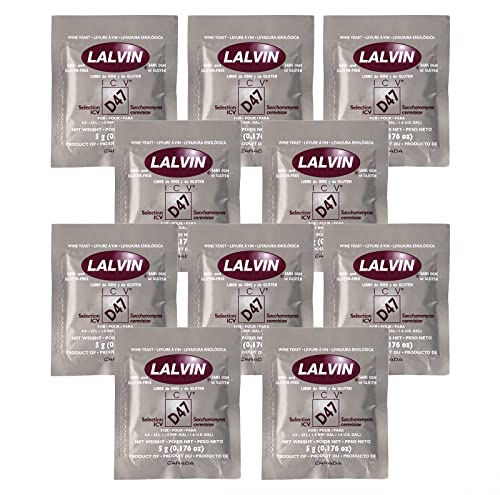
- Lalvin ICV-D47: a white wine strain Lallemand selected in the Côtes du Rhône and recommends for Chardonnay, with 15% alcohol tolerance and a range of 15 to 28 °C (59 to 82 °F). It suits a dry wine with some body.
- Lalvin EC-1118: 18% tolerance, 10 to 30 °C (50 to 86 °F), neutral and fast. Choose it if you want the surest finish.
Both comfortably handle a wine started near 1.090. Never use bread yeast; Virginia Tech says to use a wine yeast. More strains are compared on our best wine yeasts page.
How to Make Banana Wine, Step by Step
Step 1: Sanitize
Clean and sanitize the bucket, spoon, muslin and jug before anything touches the fruit.
Step 2: Mash the fruit
Peel the bananas, weigh 4½ pounds of fruit and mash it in the primary fermenter. Finely chop ½ pound of the skins and add them.
Step 3: Pour on the sugar water
Bring 6½ pints of water to a boil, dissolve the sugar completely, pour it over the fruit and skins, and cover the bucket.
Step 4: Add the rest when cool
When the must is at room temperature, stir in the grape concentrate, citric acid, tannin and yeast nutrient. This is the moment to take a gravity reading. Then add the activated yeast and cover again.
Step 5: Two days on the fruit
Keller ferments vigorously for just two days, then strains the must through muslin into a secondary, a 1 gallon glass jug, and fits an airlock. Strain gently; banana pulp is soft and clogs a cloth quickly.
Step 6: Ferment dry and wait for it to clear
Let it ferment to dryness, then rack, top up and refit the airlock. Keller allows 90 days for the wine to clear.
Step 7: Age, stabilize and bottle
When it is clear, rack again, top up and age it for 2 months. Stabilize, wait a final 30 days, then bottle and let the bottles rest 3 months before you drink them. Our guide to bottling and corking covers the last step.
Clearing a Cloudy Banana Wine
A haze that will not settle is the most common problem with banana wine. Keller’s instruction is specific: if the wine does not clear on its own in the 90 days, add amylase according to its instructions. Amylase is an enzyme that breaks down starch, and starch is the usual reason a banana wine stays cloudy; pectic enzyme, the usual fix for fruit wine haze, works on pectin instead.
Two habits help before you reach for it. Do not boil the fruit itself: NDSU notes that heating fruit can cause a pectic haze, which is why the recipe pours hot sugar water over the bananas rather than cooking them. And rack carefully, leaving the thick sediment behind each time.
Scaling Up: 5 Gallon Banana Wine
Multiply each ingredient by five and check the gravity the same way.
| Ingredient | 1 gallon | 5 gallons |
|---|---|---|
| Peeled ripe bananas | 4½ lb | 22½ lb |
| Banana skins, chopped | ½ lb | 2½ lb |
| White grape concentrate | 12 oz | 60 oz |
| Granulated sugar | 1¾ lb | 8¾ lb |
| Citric acid | 2 tsp | 10 tsp |
| Grape tannin | ⅛ tsp | ⅝ tsp |
| Water | 6½ pints | 32½ pints |
| Yeast nutrient | 1 tsp | 5 tsp |
| White wine yeast | 1 packet | 1 packet (check the packet’s batch size) |
That is a lot of banana pulp. Use a 7 to 8 gallon bucket for the primary and a 5 gallon carboy after straining; our carboy vs bucket guide compares them.
What you need for a 1 gallon batch
Gear and additives for the recipe card. You add the bananas, sugar and grape concentrate.
-
1Fermenting kit
Home Brew Ohio Upgraded 1 Gallon Wine from Fruit Kit
A 1 gallon kit for fruit wine; the listing says it includes instructions, a recipe book and a mini auto-siphon for racking.
-
2Jug and airlock
FastRack 1 Gallon Glass Jug with Bung and Airlock
If you already have a bucket: a clear 1 gallon glass jug with a drilled #6.5 bung, twin bubble airlock and polyseal cap, per the listing.
-
3Straining bag
Bellamei Brew Bags, 16 x 11 and 18 x 16 Inch (2 Pack)
Fine 250 micron mesh for straining the soft banana pulp after two days, in place of the muslin in Keller’s method.
-
4White wine yeast
Lalvin ICV-D47 Wine Yeast, 10 Pack
A white wine strain the listing ties to full-bodied Chardonnay; Lallemand rates it at 15% alcohol.
-
5Grape tannin
North Mountain Supply Wine Tannin, 2 oz
For the ⅛ teaspoon of tannin on the card; a small jar lasts many batches.
-
6Yeast nutrient
The listing doses it at 1 teaspoon per gallon before fermentation begins, the amount on the card.




Common Mistakes With Banana Wine
Boiling the bananas
Pour the hot sugar water over the fruit instead. Cooking fruit sets haze that is hard to remove later.
Leaving it on the pulp too long
Keller strains after two days. Banana pulp breaks down into a thick sludge, and more time on it only makes straining and clearing harder.
Giving up on a cloudy wine
Allow the full 90 days, and use amylase if it still will not clear. Patience fixes most banana wine haze.
Sweetening without stabilizing
If you like it semi-sweet, as Keller does, stabilize first. Virginia Tech points out that adding sugar to a finished wine makes it unstable, because fermentation could start again.
For the method behind every fruit wine see how to make wine from fruit, and browse the recipe collection for more. Make and drink wine responsibly, and only if you are of legal drinking age.