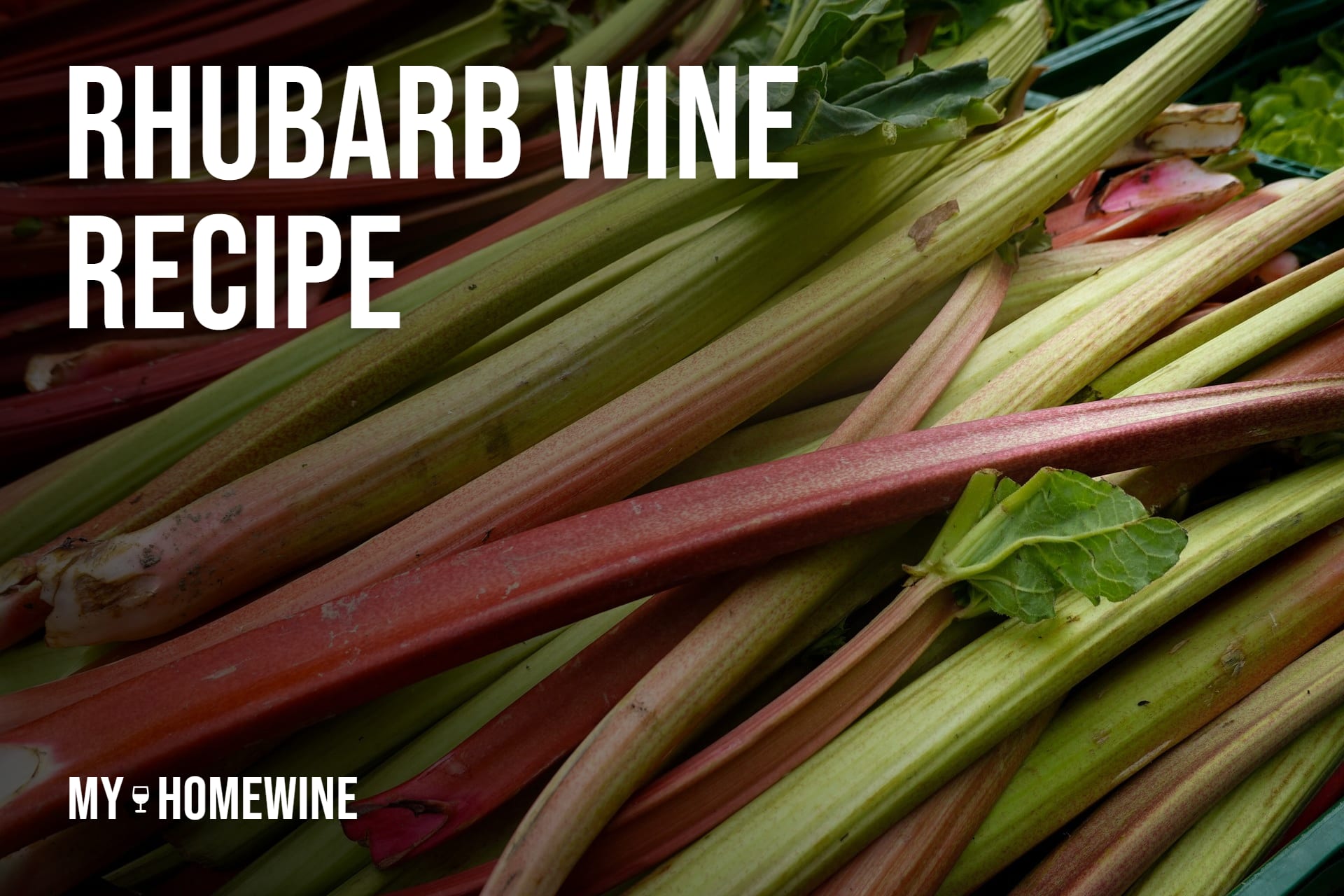
Rhubarb Wine Recipe
As an Amazon Associate we earn from qualifying purchases. How we choose products.
On this page
The short answer: for one gallon of rhubarb wine, chop 3 pounds of rhubarb stalks and freeze them for a few days. Thaw, mash and squeeze the juice into the primary, add the pulp in a straining bag, then ¼ pint of white grape concentrate, about 2½ pounds of sugar (to a gravity of about 1.090), ¼ teaspoon of tannin, 1 teaspoon of yeast nutrient and a crushed Campden tablet. Wait 24 hours, add wine yeast, and rack into a jug when the gravity falls to 1.030 to 1.040.
That is the rhubarb wine in North Dakota State University Extension’s home winemaking guide. Rhubarb grows almost anywhere in the northern US, comes up early in spring, and makes a crisp, pale wine. Use only the stalks: the leaves are poisonous.
Recipe card
Rhubarb wine, 1 US gallon
- Makes
- About 5 bottles (750 ml)
- Time to drink
- 3 to 6 months
- Difficulty
- Easy
Ingredients
- 3 lb rhubarb stalks, leaves removed
- ¼ pint white grape frozen concentrate, free of preservatives
- About 2½ lb sugar, to a specific gravity of 1.085 to 1.090
- Water to make 1 gallon
- ¼ tsp tannin
- 1 tsp yeast nutrient
- 1 Campden tablet, crushed
- 1 packet wine yeast, such as EC-1118 or K1-V1116
Method
- Wash the rhubarb, chop it into small pieces and freeze it for several days.
- Thaw, put it in a nylon straining bag, mash and squeeze the juice into the primary, and leave the bag of pulp in the fermenter.
- Add everything except the yeast, stir, check the gravity and add sugar if needed. Cover and leave 24 hours.
- Add the yeast and keep the must at 68 to 75 °F.
- After three to five days, when the gravity is 1.030 to 1.040, rack into a jug with plenty of headspace and fit an airlock.
- When fermentation is over, rack off the sediment, clear, top up and rack again before bottling.
Recipe from NDSU Extension, Getting Started With Home Winemaking (FN1638), adapted there from the Winemaker’s Recipe Handbook, the Winepress Recipe Book and the Winemaking Home Page.
Where This Recipe Comes From
North Dakota State University Extension’s Getting Started With Home Winemaking (FN1638) includes rhubarb among its tested fruit recipes, with 3 pounds of rhubarb and a quarter pint of white grape concentrate per gallon. Freezing the stalks first and squeezing them in a bag is NDSU’s way to get the juice out without cooking.
Jack Keller’s Requested Recipes Collection (2020) has a second, stronger-flavored version, made with 6 to 7 pounds of rhubarb and precipitated chalk to bring down the acid. Keller writes that rhubarb wine is one you either love or hate, and that it is excellent for blending because it takes on the flavor of whatever it is blended with. His version is below the main recipe.
Choosing and Preparing the Rhubarb
Red or green stalks
Any firm, healthy stalks will make wine. Red stalks give a pink tint; Keller specifies red rhubarb for both of his rhubarb wines.
Trim, wash and chop
Cut off every leaf and the leaf base, rinse the stalks, and chop them into short pieces. Keller wipes them clean rather than peeling them.
Freeze, then squeeze
NDSU freezes the chopped rhubarb for several days, thaws it and squeezes the juice out through a nylon bag. NDSU’s general guide explains that freezing and thawing softens fruit and helps with juice extraction, while heating fruit can cause a pectic haze. Keller suggests the same trick for spreading the work out: freeze enough rhubarb, or its juice, for another batch later.
Sugar, Acid and Strength
Sugar to a gravity, not a weight
NDSU lists about 2½ pounds of sugar, plus or minus, to reach a specific gravity of 1.085 to 1.090; its method then allows topping the must up to 1.095. Virginia Tech’s Wine Making for the Home Gardener explains that a gravity of about 1.090 gives about 12% alcohol. Add the sugar in steps and measure; our sugar calculator and hydrometer guide help.
No acid blend
Notice what the NDSU recipe leaves out. Most fruit wine recipes add acid blend, but rhubarb has plenty of its own; Keller describes it as fairly high in acidity. That sharpness is what his chalk version sets out to reduce.
Jack Keller’s Rhubarb Wine With Chalk
If you like the taste of rhubarb and want more of it, Keller’s version uses twice the fruit and deals with the acid directly. Rhubarb contains an excess of oxalic acid, he explains, which is what gives it the taste some people dislike, and precipitated chalk (calcium carbonate) removes it.
- 6 to 7 lb red rhubarb, cut into ½ inch lengths and crushed
- 1 gallon cold water with 1 crushed Campden tablet dissolved in it, poured over the rhubarb
- 3 days covered, stirring daily, then strain and squeeze the pulp hard
- 1 oz precipitated chalk stirred into the liquor; it fizzes, then settles. Taste after 3 hours and add another ½ oz if the acid is still too sharp
- 1¾ lb finely granulated sugar, the juice of 2 large lemons and 1½ tsp yeast nutrient
- A Sauternes-style wine yeast
Keller holds back about a pint in a small bottle plugged with cotton to allow for foaming, tops up when the ferment settles after 5 to 7 days, racks when the wine begins to clear, and racks again at least two months later. He suggests cold stabilizing for 30 days if you can. Bottled pure, he says, it is drinkable right away; for a 3 to 5 gallon batch he adds ⅛ teaspoon of tannin per gallon to extend its life.
The Best Yeast for Rhubarb Wine
NDSU’s recipe names two options, EC-1118 or K1-V1116; Keller uses a Sauternes yeast for his chalk version, which is harder to find. Lallemand’s figures for Lalvin EC-1118 are 18% alcohol tolerance and 10 to 30 °C (50 to 86 °F), neutral in flavor and fast, which suits a delicate wine you do not want the yeast to mask. Keep the must at the 68 to 75 °F NDSU gives for the start of fermentation. More strains are compared on our best wine yeasts page.
How to Make Rhubarb Wine, Step by Step
Step 1: Freeze the rhubarb
Trim, wash and chop 3 pounds of stalks, bag them and freeze them for several days.
Step 2: Sanitize
Clean and sanitize the bucket, straining bag, spoon and jug.
Step 3: Extract the juice
Thaw the rhubarb in the straining bag, then mash and squeeze the juice into the primary fermenter. Leave the bag of pulp in the bucket.
Step 4: Build the must
Add the grape concentrate, water to one gallon, tannin, nutrient and crushed Campden tablet, then the sugar. Stir well, measure the gravity and add sugar a little at a time until you reach your target. Cover loosely with the lid or a clean towel and leave 24 hours.
Step 5: Primary fermentation
Add the yeast and keep the must at 68 to 75 °F. Check the gravity after three to five days.
Step 6: Rack to the jug
At 1.030 to 1.040, rack into a jug, leaving plenty of headspace so the active fermentation does not push wine out of the top, and fit an airlock.
Step 7: Finish, clear and bottle
NDSU checks again after about three weeks. When fermentation is over, rack off the sediment, add a clearing agent, top up with water or a white wine to about 2 inches below the stopper, and refit the airlock. After at least two weeks, if it is clear, rack again and bottle, or leave it a few more weeks; NDSU notes that more time in the jug usually gives a better-looking wine. Our guide to bottling and corking covers the last step.
Scaling Up: 5 Gallon Rhubarb Wine
Multiply each ingredient in the NDSU recipe by five and keep the same gravity target.
| Ingredient | 1 gallon | 5 gallons |
|---|---|---|
| Rhubarb stalks | 3 lb | 15 lb |
| White grape frozen concentrate | ¼ pint | 1¼ pints |
| Sugar (to 1.085 to 1.090) | about 2½ lb | about 12½ lb |
| Water | to 1 gallon | to 5 gallons |
| Tannin | ¼ tsp | 1¼ tsp |
| Yeast nutrient | 1 tsp | 5 tsp |
| Campden tablets | 1 | 5 |
| Wine yeast | 1 packet | 1 packet (check the packet’s batch size) |
Use a 7 to 8 gallon bucket for the primary and a 5 gallon carboy after that; our carboy vs bucket guide compares them.
What you need for a 1 gallon batch
Gear and additives for the recipe card, plus the chalk for Keller’s version. You add the rhubarb, sugar and grape concentrate.
-
1Fermenting kit
Home Brew Ohio Upgraded 1 Gallon Wine from Fruit Kit
A 1 gallon kit for fruit wine; the listing says it includes instructions, a recipe book and a mini auto-siphon for racking.
-
2Jug and airlock
FastRack 1 Gallon Glass Jug with Bung and Airlock
If you already have a bucket: a clear 1 gallon glass jug with a drilled #6.5 bung, twin bubble airlock and polyseal cap, per the listing.
-
3Straining bag
Bellamei Brew Bags, 16 x 11 and 18 x 16 Inch (2 Pack)
NDSU thaws, mashes and squeezes the rhubarb in a nylon bag and leaves the bag of pulp in the fermenter; these mesh bags do that job.
-
4Wine yeast
Lalvin EC-1118 Wine Yeast (10 Pack)
One of the two strains the NDSU recipe names; Lallemand rates it to 18% alcohol, neutral and fast.
-
5Wine tannin
North Mountain Supply Wine Tannin, 2 oz
For the ¼ teaspoon of tannin in the NDSU recipe.
-
6Yeast nutrient
The listing doses it at 1 teaspoon per gallon before fermentation begins, the amount on the card.
-
7Campden tablets
Craft A Brew Campden Tablets, 50 Count
Sodium metabisulfite tablets labeled at one tablet per gallon, crushed before use.


Strawberry Rhubarb Wine
Rhubarb’s habit of taking on other flavors makes it a natural partner for strawberries. Keller calls strawberry-rhubarb a great combination: strawberry is low to medium in acidity and rhubarb fairly high, so the two ferment well together. His strawberry-rhubarb wine uses 4 pounds of strawberries and 2 pounds of rhubarb per gallon, with white grape concentrate for body. You can also make the two wines separately and blend them to taste; start from our strawberry wine recipe.
Common Mistakes With Rhubarb Wine
Leaving leaves in the bucket
Trim every leaf. They are the toxic part of the plant.
Adding acid blend out of habit
Rhubarb already brings plenty of acid. Neither NDSU nor Keller adds acid blend.
Too little headspace
NDSU warns to leave plenty of room in the jug, because the active fermentation can push wine out of the top.
Judging it too young
Keller writes that rhubarb has its own flavor, which can be exceedingly smooth when aged a year.
For the method behind every fruit wine see how to make wine from fruit, and browse the recipe collection for more. Make and drink wine responsibly, and only if you are of legal drinking age.