Step-by-step guide
How to Make Cider from Apples (Sweet Cider and Hard Cider)
As an Amazon Associate we earn from qualifying purchases. How we choose products.
On this page
To make cider from apples, you wash and sort ripe apples, grind them into a coarse pulp, press the juice out, and then either pasteurize it as sweet cider or ferment it into hard cider. A bushel of apples, about 42 lb, gives roughly three gallons of juice, according to University of Missouri Extension. The grinding is the step most people skip, and it is the one that decides how much juice you get.
This guide is the part before fermentation: choosing and blending apples, how many you need, grinding and pressing with or without a press, and keeping sweet cider safe. When the juice is in the jug, our recipe on how to make hard cider takes over. The numbers here come from the extension services of the University of Missouri, Oregon State University and the University of Illinois, and from the FDA; we did not run our own yield trials.
Sweet Cider vs Hard Cider vs Apple Juice
In the US the words overlap, so it is worth being precise.
| Sweet cider | Hard cider | Apple juice (store) | |
|---|---|---|---|
| What it is | Fresh pressed, unfiltered juice | Fermented apple juice | Filtered, pasteurized juice |
| Alcohol | None | About 2 to 8% (Missouri Extension) | None |
| Looks | Cloudy, brown | Clears with time | Clear |
| Keeps | Days in the fridge, months frozen | Months to years, bottled | Months, sealed |
Oregon State University Extension describes sweet cider as made from fresh crushed apples, not cooked or chemically preserved, and hard cider as what you get when it ferments. Shelf stable apple juice is the shortcut: it makes good hard cider, but it is not what this page is about.
Choosing Apples for Cider
Blend Sweet, Tart and Tannic
Single variety cider is often flat. Missouri Extension says juice from at least three or four cultivars gives a more complex flavor, and describes the old Missouri blend: Jonathan, Golden Delicious and Red Delicious in equal parts, for acidity, sweetness and aroma. The same article sorts common varieties like this:
- Tart (medium to high acid): Granny Smith, Empire, Arkansas Black, Rome Beauty, McIntosh, Pink Lady, Winesap, York.
- Sweet: Gala, Fuji, Honeycrisp.
- Sweet and tart: Braeburn, Jonagold, Mutsu.
- Tannic (astringent): Kingston Black, Dabinett, Porter's Perfection, Hewe's Crab, at about 10 to 20% of the blend.
Oregon State's list of common cider apples adds Delicious, McIntosh, Rome and Gravenstein. If you cannot find tannic cider apples, a handful of crab apples or a little wine tannin in the fermenter does a similar job for hard cider.
Ripeness
Use ripe fruit. Missouri Extension says red or yellow apples should show no green undercolor, because under ripe fruit gives a starchy flavor, and that slightly under ripe apples can be left at room temperature to finish ripening before pressing. Oregon State says to select apples that are just ripe for eating.
Windfalls and Blemished Fruit
Cosmetic flaws are fine. Missouri Extension notes that utility grade apples with russeting, limb rubs or insect stings can be used, as long as the skins are not broken, and they cost less. Fallen apples are a different matter for sweet cider: the same article says fruit from the ground may be contaminated with animal feces and should not be used. For hard cider, a Washington State University article quotes a cider researcher who treats fermentation as a kill step for patulin and pathogens, so trimmed and well washed windfalls can be used there.
How Many Apples Do You Need?
Missouri Extension and Illinois Extension both put one bushel at about three gallons of cider, and Missouri gives the bushel as about 42 lb. That works out to roughly 14 lb of apples per gallon, our arithmetic from their figures. Expect less with a kitchen setup and soft, old apples, and more with a good grinder and a heavy press.
| Juice wanted | Apples (approx.) | Bushels |
|---|---|---|
| 1 gallon | 14 lb | 1/3 |
| 3 gallons | 42 lb | 1 |
| 5 gallons | 70 lb | 1 2/3 |
| 6 gallons | 84 lb | 2 |
A 1 gallon batch is a good first run. It fits in one glass jug, one person can press it in an afternoon, and it tells you whether your blend is worth scaling up. Our grape and fruit calculator is useful if you want to compare apples with other fruit.
How to Make Cider from Apples, Step by Step
1. Clean and Sort
Sanitize the work area and wash the fruit, as Missouri Extension advises. Cut out bruised, rotten or bitten parts. Poor fruit gives poor cider, and one rotten apple can taint a whole pressing. Peeling is optional: Missouri says apples may be peeled or not, depending on the flavor you want, and most cider makers leave the skins on.
2. Grind the Apples
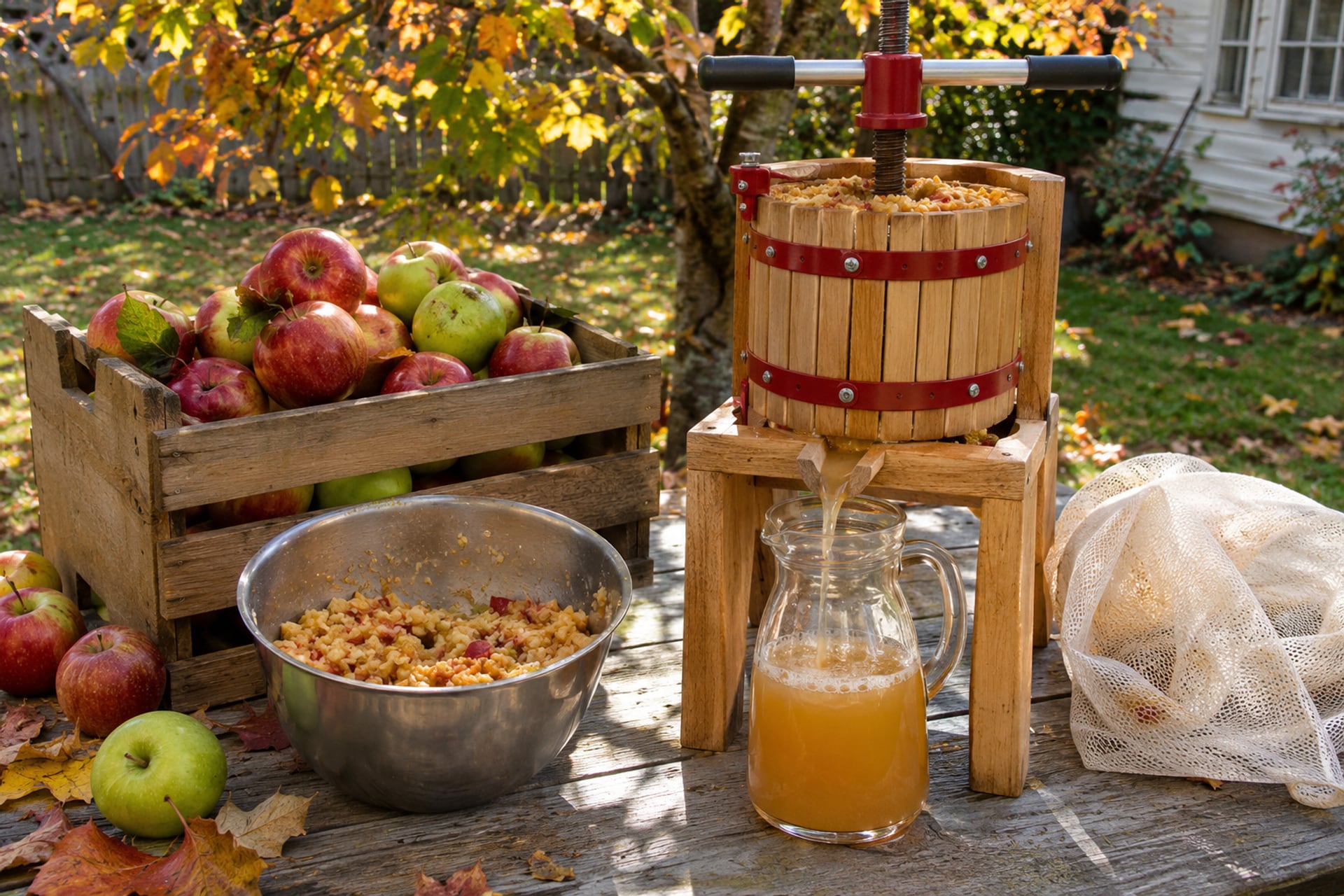
Whole apples give very little juice in a press. Oregon State University Extension says grinding is necessary to release the juice. For small batches, it suggests quartering unpeeled apples and running them through a kitchen food grinder or chopping them in a food processor. For larger batches, a cider mill with a crusher or grinder attached is faster, and Oregon State notes these can be rented or borrowed. Aim for coarse pulp, like rough applesauce, not puree; puree clogs the press bag.
3. Let the Pulp Rest
Oregon State says that letting the crushed fruit stand for 30 minutes to an hour will yield more cider. The pulp will brown a little. That is normal and adds color.
4. Press
Load the pulp into a mesh bag inside the press basket, fold the bag over, put the pressing plate on and turn the screw. Oregon State's advice is to apply pressure slowly and evenly. Press until the flow slows to drips, wait a few minutes, and give it another turn. Strain the juice through a clean cloth as it drips into the pan; fresh pressed cider is cloudy, and that is expected.
5. Pressing Without a Press
For small batches, Oregon State describes a homemade method: a strong jelly bag and a rolling pin, pressed slowly and steadily so the bag does not burst. It is slow work and takes some strength, so it suits a gallon, not a bushel. A sturdy mesh brew bag twisted by two people does the same job a little faster.
6. Chill or Pasteurize
Missouri Extension says to refrigerate or freeze cider right after juicing, in sanitized containers. If you are drinking it as sweet cider, decide now whether to pasteurize; see the next section. If you are fermenting it, go straight to the fermenter.
Gear for pressing cider at home
A small press, a bag and a bigger press for when you scale up. For the full comparison, see our guide to the best cider press.
-
1Small batch press
VEVOR 1.6 Gallon Fruit Wine Press
A beech basket press with pressing blocks and two filter bags, sized for 1 gallon batches. The listing says hard fruit must be crushed first.
-
2Press bag
Bellamei Brew Bag, 2 Pack, 22 x 26 in
250 micron nylon mesh bags with a drawstring; the listing names cider and wine press straining among the uses.
-
3When you scale up
EJWOX 4.75 Gallon Fruit and Wine Press
A larger beech basket press with a stand and pour spout, sized for a bushel day rather than a single gallon.


Making Sweet Cider Safe
Fresh pressed cider can carry bacteria from the fruit. The FDA says that unless the produce or juice has been pasteurized or otherwise treated, the juice could be contaminated, and that untreated juice sold at cider mills and farmers' markets must carry a warning label. Missouri Extension links past outbreaks of E. coli, Salmonella and Cryptosporidium to unpasteurized cider made with dropped apples, and recommends pasteurization for infants, young children, pregnant women, older adults and anyone with a weakened immune system.
How to Pasteurize Cider at Home
Oregon State University Extension says to heat the juice to at least 160 °F and hold it there for 6 seconds. If you do not have a thermometer that reads that high, it says to heat the juice until it simmers, when bubbles appear on the surface. Missouri gives a range of 160 to 185 °F. Pour the hot cider into sanitized containers and refrigerate or freeze it immediately.
How Long Sweet Cider Keeps
The sources differ, so use the shortest figure. Illinois Extension says to use heat treated cider within 5 days, Oregon State says about a week, and Missouri says about three weeks. Missouri also notes that potassium sorbate can extend the storage life of refrigerated cider; see our guide to potassium sorbate. For longer storage, freeze it, leaving at least 2 inches of headspace, as Oregon State advises, because cider expands as it freezes.
Fresh Cider Starts to Ferment on Its Own
Unpasteurized cider carries wild yeast. Left in the fridge for a week or two, it starts to fizz and turn tangy. That is fermentation starting. If you want hard cider, that is fine, but it is better to control it with a chosen yeast, as below.
Turning Your Apple Cider into Hard Cider
Fresh pressed juice is the best base you can have for hard cider. The fermentation itself is short to describe:
- Check the sugar. Take a hydrometer reading. The sugar in fresh juice varies with the variety, the ripeness and the season, so measure it rather than guess, and write the reading down. Our ABV calculator gives the exact figure.
- Treat the juice. Either add one crushed Campden tablet per gallon and wait 24 hours, or pasteurize gently, as Penn State Extension advises for fresh pressed juice.
- Add yeast and nutrient. A cider or white wine yeast, plus nutrient. See our wine yeast guide for strains.
- Ferment in a jug under an airlock until the gravity stops falling. Penn State Extension says cider fermentation runs for approximately two weeks, depending on the sugar content and room temperature.
- Rack, clear and bottle. The full method, including sweet and sparkling versions, is in our hard cider recipe.
If you would rather buy everything in one box, our guide to cider making kits compares the options, and fresh juice from your own press works with any equipment kit.
Is It Cheaper to Make Your Own Cider?
It depends on your apples. If you have trees or a neighbor who wants windfalls gone, the juice is nearly free and the only real cost is a press. If you buy apples by the bushel, the price of the fruit decides it. The press is the expensive part, and it lasts for years; a small basket press sits in the budget tier ($), while hydraulic presses sit at the top ($$$). See our guide to the best cider press before you buy.
Wine and cider are for adults of legal drinking age. Enjoy them responsibly.