Homemade wine guide
Potassium Sorbate in Wine: How Much, When, and What It Can't Do
As an Amazon Associate we earn from qualifying purchases. How we choose products.
On this page
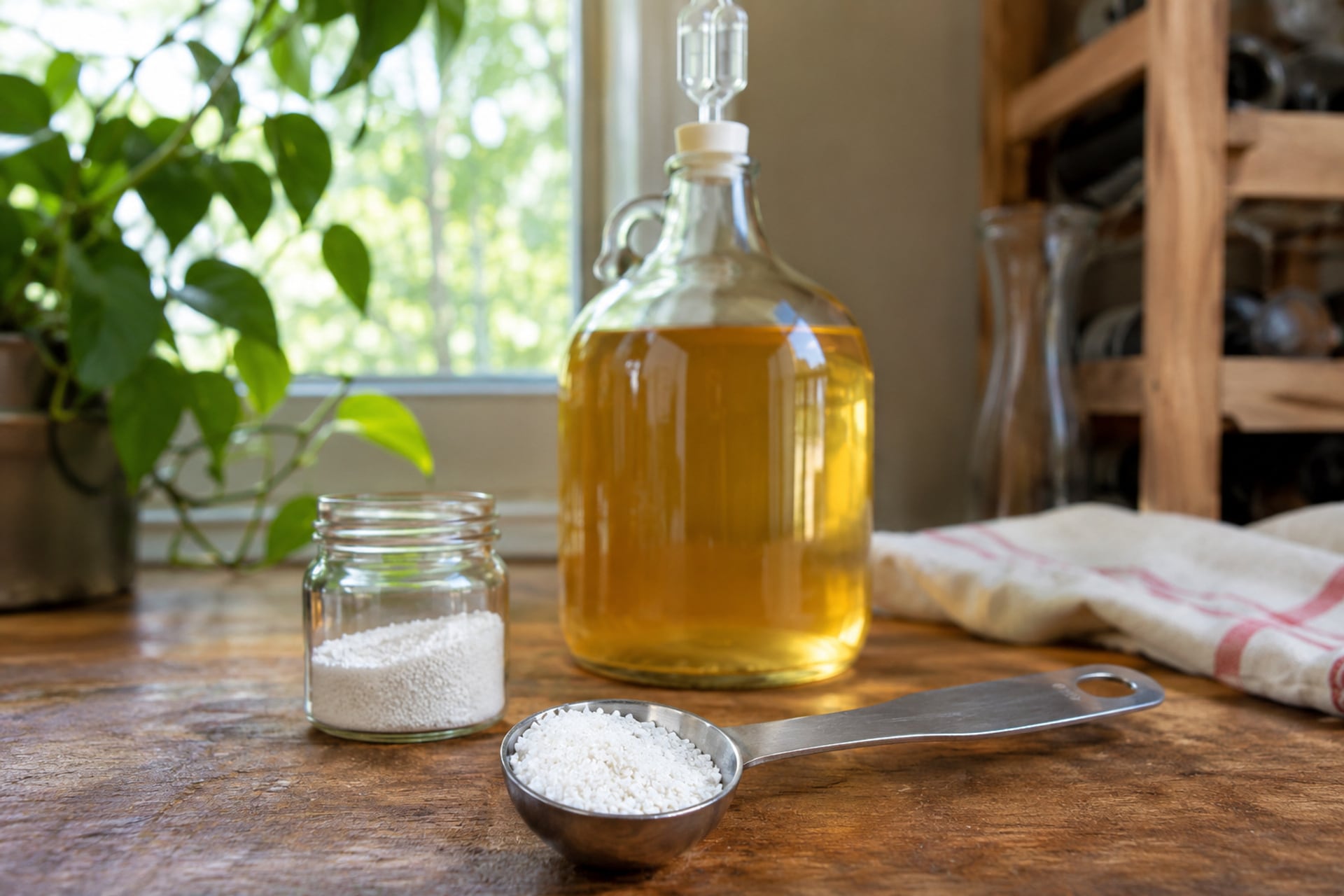
Potassium sorbate in wine has one job: it keeps yeast from multiplying, so a finished wine that still has sugar in it does not start fermenting again in the bottle. The usual home dose is 1/2 teaspoon per gallon, added after fermentation has ended and the wine has cleared, together with sulfite. It is the step that makes sweet homemade wine, cider and mead safe to bottle.
It is also the most misunderstood additive on the shelf. Potassium sorbate does not kill yeast and it will not stop a fermentation that is already running. Used in a wine that has gone through malolactic fermentation, it can leave a smell of crushed geranium leaves that nothing removes. Below we cover the dose, the timing, the limits, and the safety questions people ask, with the source for every number. We did not run lab trials; the figures come from WineMaker magazine, North Dakota State University (NDSU) Extension, the Australian Wine Research Institute (AWRI) and the federal rules for wine.
What Potassium Sorbate Does in Wine
Potassium sorbate is the potassium salt of sorbic acid. The federal list of materials authorized for treating wine, 27 CFR 24.246, names it exactly that way and gives its use as preserving wine and inhibiting mold growth and secondary fermentation. In home winemaking it is sold as wine stabilizer, and it does one thing well: it stops yeast cells from reproducing.
That matters because a sweet wine is food for yeast. NDSU Extension says to use sorbate whenever a wine has residual sugar after fermentation or you plan to sweeten it before bottling, and warns that skipping it can make bottles explode if fermentation restarts. A few surviving yeast cells, a warm cupboard and a few grams of sugar are all it takes.
Sorbate Stops Reproduction, Not Fermentation
The Northern Brewer listing says it plainly: potassium sorbate does not stop active fermentation, and it inhibits yeast reproduction, not activity. If the airlock is still bubbling, the yeast already in the wine can keep eating sugar whether you add sorbate or not. Sorbate only works on a wine that has finished, where the job is to stop a small surviving population from growing back.
Why It Needs Sulfite
Every source we checked pairs sorbate with sulfite. WineMaker's backsweetening guide says wines that are backsweetened need the combination of potassium sorbate and metabisulfite, because sorbate prevents further yeast reproduction while the sulfite deals with the yeast and bacteria that remain. On its own, sorbate only slows the yeast down, and a slowed yeast can recover once you give it sugar. One crushed Campden tablet per gallon is the usual home sulfite dose; our sulfite calculator works out the exact amount for your batch.
How Much Potassium Sorbate per Gallon
The standard home dose is 1/2 teaspoon per gallon. WineMaker gives sorbate at a 1/2 teaspoon per gallon (3.8 L) along with a normal bottling sulfite dose, and Northern Brewer gives the same 1/2 teaspoon per gallon of wine or cider once fermentation is complete. Scaled to common batch sizes:
| Batch | Potassium sorbate | Campden tablets (usual home dose) |
|---|---|---|
| 1 gallon | 1/2 tsp | 1 |
| 3 gallons | 1 1/2 tsp | 3 |
| 5 gallons | 2 1/2 tsp | 5 |
| 6 gallons | 3 tsp (1 tbsp) | 6 |
The scaling is our arithmetic from the 1/2 teaspoon figure. If your wine is high in alcohol, or you have already lowered the pH, the sulfite side of the table can change; the calculator takes pH into account.
The Legal Ceiling
Commercial wine in the US may contain no more than 300 mg/L of sorbic acid, according to 27 CFR 24.246. Here is how that compares with the home dose. Sorbic acid makes up about 74.6% of potassium sorbate by weight (molar masses of 112.13 and 150.22). A gallon is 3.785 liters, so 300 mg/L allows about 1.14 g of sorbic acid per gallon, or about 1.52 g of potassium sorbate. That is our arithmetic, not a figure from the regulation, and the regulation applies to commercial wine rather than to your cellar. It is still a useful yardstick: weigh your 1/2 teaspoon once (see below) and you will know how far under it you are. The practical rule is simple: do not double the dose because a wine tastes very sweet. The sweetness is the reason you need sorbate, not a sign that you need more of it.
Weigh It If You Can
Granules and powders pack differently, so a teaspoon is an approximation. If you have a scale that reads 0.1 g, weigh your own teaspoon once and write the figure on the jar. For a 1 gallon batch the difference does not matter much; for 6 gallons it is worth knowing.
When to Add Potassium Sorbate
Add it at the end, not the start. The wine should be finished, clear and racked off its sediment. WineMaker's sequence for a wine you plan to sweeten is the one we follow:
- Confirm fermentation is over. Take two hydrometer readings a few days apart. If they match, and the wine is dry or at the gravity you expected, it is done. A stopped airlock is not proof; see our stuck fermentation guide if the gravity is still high.
- Rack the wine off the lees into a clean vessel. Sorbate works best when there are fewer yeast cells left, which is why Northern Brewer says to add it only after the wine has been racked. Our guide on how to rack wine shows the method.
- Add the sulfite and stir gently.
- Wait 12 hours, then add the potassium sorbate, dissolved first in a little water or wine. WineMaker calls this good practice.
- Wait another 48 hours before adding sugar, again per WineMaker.
- Sweeten, then watch the wine for a week or two before bottling. If you see new bubbles or a film, the stabilizing did not hold.
The full sweetening method, including how to judge how much sugar to add, is in our guide to backsweetening wine.
How to Dissolve It
Stir the measured sorbate into a few tablespoons of warm water or a cup of the wine until it disappears, then stir it gently into the batch. The Home Brew Ohio listing says it dissolves completely in wine, and that matches what you should see: no grains on the bottom. Stir gently to avoid splashing air into a finished wine.
Before Bottling Without Sweetening
If the wine is completely dry and you are not adding sugar, you do not need sorbate. There is nothing left for the yeast to eat. Sulfite alone protects a dry wine against oxidation and spoilage at bottling. Our bottling and corking guide covers that routine.
What Potassium Sorbate Cannot Do
It Cannot Rescue an Active Fermentation
If the wine is still fermenting and you want it sweeter, sorbate is the wrong tool. Let it finish, then stabilize and sweeten. Chilling and racking can slow a fermentation, but at home there is no easy way to be sure the yeast is gone, and a wine bottled mid fermentation is the classic way to make bottles burst.
It Does Not Sterilize Equipment
Sorbate goes into the wine, not on your gear. Clean and sanitize bottles and tubing with a proper sanitizer such as Star San.
It Does Not Fix a Faulty Wine
Sorbate will not remove a vinegar or rotten egg smell. If something is wrong, read our wine faults guide first; stabilizing a faulty wine only preserves the fault.
It Does Not Keep Opened Wine Fresh
Once a bottle is open, oxygen is the problem, not yeast. Recork it and refrigerate it. Our guide to how long homemade wine lasts has the numbers.
Potassium Sorbate in Cider and Mead
The same rules apply. Northern Brewer's dose of 1/2 teaspoon per gallon is written for wine or cider, and Craft A Brew sells its sorbate for backsweetening mead, cider and wine. For a sweet hard cider, stabilize with sulfite and sorbate before adding sugar or juice, and remember that a stabilized cider cannot be carbonated in the bottle: the yeast will not eat the priming sugar either. If you want sweet and sparkling, that takes a keg or pasteurization.
For sweet cider that you plan to drink fresh, University of Missouri Extension notes that potassium sorbate may be added to extend the storage life of refrigerated cider. That is a different use from stabilizing a finished hard cider, but the chemistry is the same.
Mead finishes slowly and sometimes stalls with sugar left, so take your hydrometer readings over a longer gap before you trust them. Our mead guide covers stabilizing a sweet mead step by step.
Is Potassium Sorbate Safe?
The regulators treat it as a routine food preservative. The FDA lists potassium sorbate under 21 CFR 182.3640 as generally recognized as safe when used in accordance with good manufacturing practice. In the European Union, potassium sorbate (E 202) is on the list of authorized oenological practices in Regulation (EU) 2019/934. Claims online that it is banned in Europe are wrong for wine: the EU rule names it explicitly. We are not doctors, and anyone with a specific allergy or condition should ask one, and the US ceiling for commercial wine is a useful reference for how much is too much.
Buying Potassium Sorbate
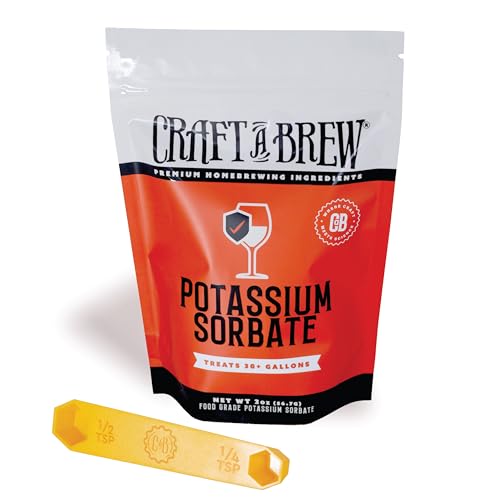
Buy food grade sorbate sold for winemaking, and buy small unless you make a lot of wine. At 1/2 teaspoon per gallon, a 2 oz jar covers a lot of batches; Craft A Brew says its 2 oz jar yields 20 or more gallons. Keep the jar sealed and dry, and write the date on it.
Potassium sorbate and what goes with it
Three sizes of sorbate, plus the sulfite you add first. All sit in the budget tier ($).
-
1Best for most batches
North Mountain Supply Potassium Sorbate, 2 oz Jar
A small, sealed jar of food grade sorbate; enough for many gallons at the standard dose.
-
2Best for cider and mead
Craft A Brew Potassium Sorbate, 2 oz
Sold for backsweetening wine, cider and mead, and rated by the seller for 20 or more gallons.
-
3Best bulk size
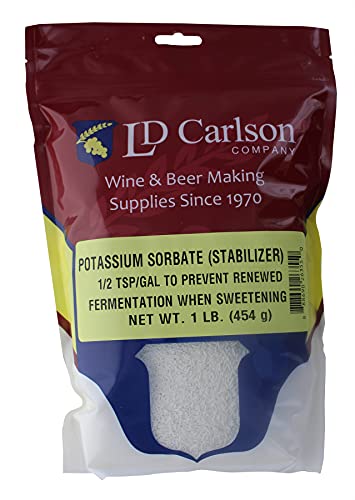
Home Brew Ohio Potassium Sorbate, 1 lb
A 1 lb bag for people who stabilize several 5 or 6 gallon batches a year.
-
4The sulfite partner
Campden Tablets (Potassium Metabisulfite), 1 lb
Add the sulfite first, wait 12 hours, then the sorbate. One tablet per gallon is the usual home dose.


Wine is for adults of legal drinking age. Enjoy it responsibly.