Homemade wine guide
Sparkolloid: How to Use It, How Much per Gallon and vs Bentonite
As an Amazon Associate we earn from qualifying purchases. How we choose products.
On this page
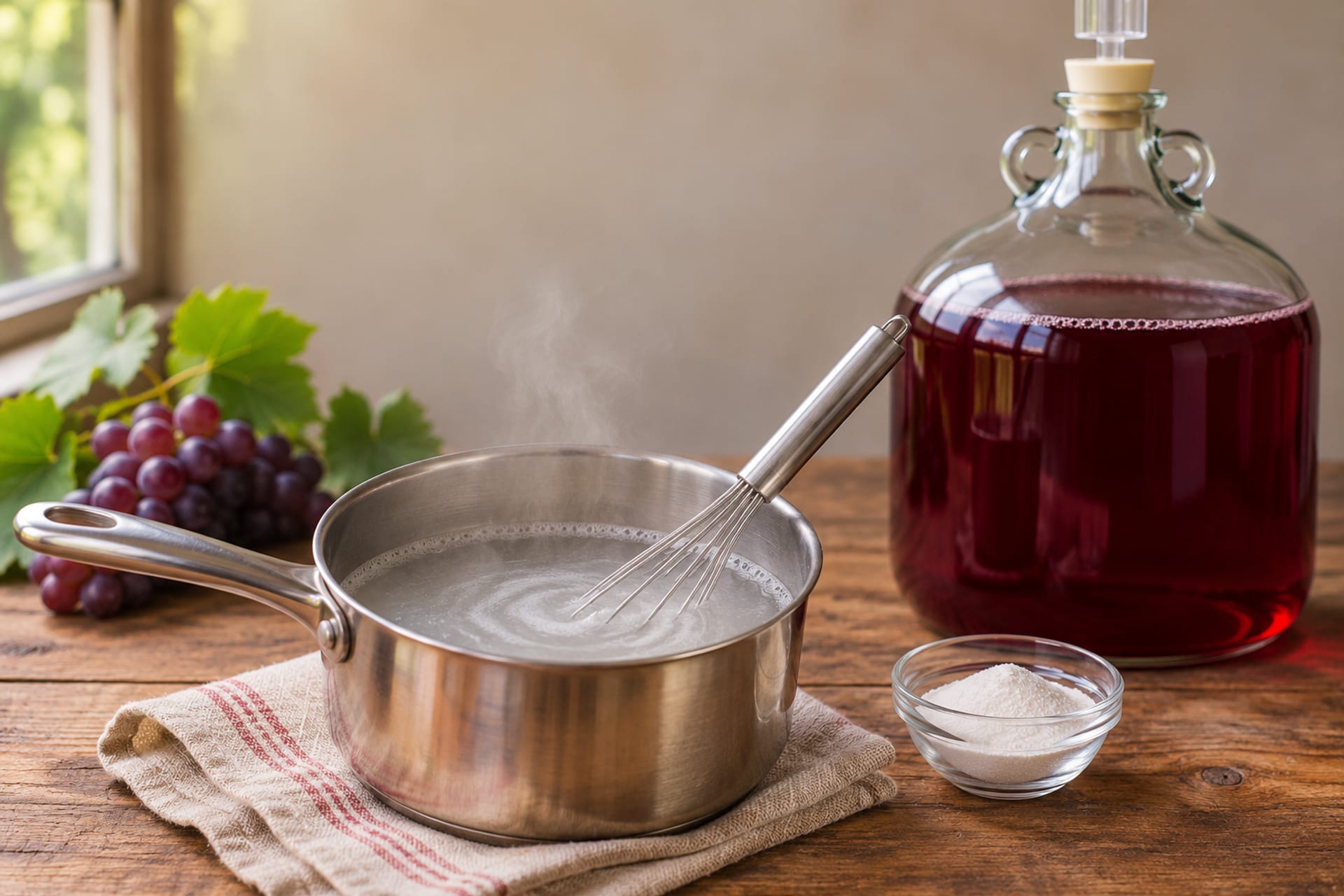
Sparkolloid is a fining powder that clears hazy wine and mead. You boil it in a little water until it turns into a smooth, creamy mix, stir it into the wine while it is still hot, and rack the clear wine off the lees after a week or more. The only rule that really matters is the hot step: Scott Laboratories, the maker of the original, says to keep the mix above 180°F (82°C) until it goes in. Scott's dose range works out to about 0.45 to 1.8 grams per gallon.
Below we cover what it is, the steps, a dose table for 1 and 5 gallons, how it compares with bentonite, how it behaves in mead and how long it takes. We did not run trials. The figures come from the Scott Laboratories data sheet for Hot Mix Sparkolloid NF, Ben Rotter's article on fining and Virginia Tech's bentonite publication, each named where it appears.
What Sparkolloid Is
The Scott Laboratories data sheet describes Hot Mix Sparkolloid NF as a fining agent made of a polysaccharide blend in a diatomaceous earth carrier. Ben Rotter's article on fining adds that it was developed by Scott Laboratories and is such a popular proprietary blend that it earns its own entry. Scott says the strong positive charge is what lets it neutralize the repelling charge of the particles in suspension, so they clump together and settle as compact lees.
What It Does
Scott says it does not remove desirable color constituents and is gentle. Rotter calls it a gentle clarifier and notes it produces fine lees. It is a clarifier, and that is all it is: Scott states plainly that it is not a cold stabilizer, a heat stabilizer or an odor remover. If your wine is cloudy because of protein haze, that is a bentonite job. Our guide to how to clear wine helps you tell the causes apart.
Hot Mix and Cold Mix
Scott sells two versions. Hot Mix is for wine; the data sheet points to its Cold Mix Sparkolloid NF for juice clarification. Rotter says the same: the cold mix is for general clarity without color stripping in juice, and the hot mix is for clarifying wine. Home brew shops sell the hot mix, so everything on this page assumes it.
How to Use Sparkolloid
Scott's winery directions use 1 to 2 gallons of water per pound of product. Converted to home size, that is about 8 to 17 ml of water per gram of Sparkolloid (our arithmetic). The steps:
- Weigh the dose from the table below.
- Boil the water. Use a clean saucepan and the water amount worked out above.
- Stir the powder in slowly so it does not clump. Scott says to slowly stir the product into the boiling water.
- Keep it hot and keep stirring. Scott says to hold the temperature above 180°F (82°C) and agitate for about 20 to 30 minutes at winery scale, until the mix is smooth and creamy. Its small lab method simmers for about 15 minutes.
- Add it to the wine while it is still hot. Scott says to keep it near boiling until it goes in. Pour it into the wine slowly and stir gently.
- Let the wine settle and rack it off the lees.
Expect Some Grit
Scott warns that Hot Mix Sparkolloid NF contains some diatomaceous earth that will not dissolve, and says constant stirring during preparation and use helps spread it. So the mix will never be a clear liquid, and that is normal.
Read Your Own Jar
The Scott data sheet is for its own product, and the jars we link are LD Carlson, whose label we could not read. Use the dose and directions printed on your jar if they differ from the numbers here, and run a small sample first if you can. Scott says laboratory trials are highly recommended.
How Much Sparkolloid per Gallon
Scott gives lab trial rates of 1, 2 and 4 lb per 1000 gallons, which it equates to 12, 24 and 48 g/hL, and lists use up to 4.0 lb per 1000 gallons. Ben Rotter's article gives the same span for the hot mix, 120 to 480 mg/L. The table converts those to home batch sizes (1 gallon is 3.785 L, so these are our arithmetic).
| Scott rate | g/hL | Per 1 gallon | Per 5 gallons |
|---|---|---|---|
| 1 lb per 1000 gal | 12 | about 0.45 g | about 2.3 g |
| 2 lb per 1000 gal | 24 | about 0.9 g | about 4.5 g |
| 4 lb per 1000 gal | 48 | about 1.8 g | about 9.1 g |
Home brew shops often give the dose in teaspoons instead, and those figures vary from one seller to the next, so check the jar you buy. If you have a scale that reads 0.1 g, weigh the powder and start at the low end of Scott's range, then step up only if the wine does not clear.
Sparkolloid vs Bentonite
Both are fining agents, and both go in near the end, but they work in opposite ways.
Charge
Virginia Tech's Bruce Zoecklein describes bentonite as principally negatively charged, which is how it binds positively charged proteins. Scott describes Sparkolloid as strongly positive, which is how it neutralizes the particles that keep a wine cloudy. Rotter's grouping says the same: positively charged particulates such as protein haze go to the negatively charged fining agents, bentonite and silica gel.
When to Use Each
| Bentonite | Sparkolloid | |
|---|---|---|
| Main job | Protein stability and clarity (Zoecklein) | Clarity, gentle (Scott, Rotter) |
| Charge | Negative | Strong positive |
| Preparation | Slurry in water, 20 ml per gram (piwine) | Boiled and added hot (Scott) |
| Effect on color | Red wine can lose up to 15% (Zoecklein) | Does not remove desirable color (Scott) |
Our bentonite guide has the full method and dose table.
Using Both
Rotter says Sparkolloid is sometimes used after bentonite fining. If you use both, add them one at a time, bentonite first, rack between them and let each one finish before the next goes in. The overview of all common agents is in how to clear wine, and the rest of the additive shelf is in wine making additives.
Sparkolloid in Mead
Rotter's article says Sparkolloid is recommended for fining meads. None of the sources we read gives a separate dose for mead, so use the wine rates above and the same hot preparation, and add it to a mead that has finished fermenting. Our mead guide covers when a mead is ready to fine.
One caution from Scott: Sparkolloid does not remove odors, so it will not cure a sulfur smell. For that you need a different fix.
How Long Sparkolloid Takes to Clear
The sources give a range. Scott's winery instructions say to let the wine settle one week or more, depending on volume, before racking or filtering. Rotter says it settles quickly, in 1.5 to 2 days, and forms fine lees. A sensible home plan is to check at two days, expect a clear wine in a week, and give it two before you decide it has not worked.
When the lees are down, rack carefully so you do not stir them up. Our guide to how to rack wine shows the method. If the wine is still cloudy after two weeks, the haze may be protein, and bentonite is the next step.
Sparkolloid for wine and mead
Two LD Carlson sizes. Both are in the budget tier ($), and the 1 oz jar is enough to start.
-
1Best for a first batch
LD Carlson Sparkolloid Powder, 1 oz
A small jar for a few gallons. Follow the directions on the jar.
-
2Best for regular use
LD Carlson Sparkolloid Powder, 1 lb
A pound of the same powder for winemakers who fine every batch or make mead.


Wine is for adults of legal drinking age. Enjoy it responsibly.