Mulberry Wine Recipe: Two Easy 1 Gallon Versions
As an Amazon Associate we earn from qualifying purchases. How we choose products.
On this page
The short answer: a 1 gallon batch of mulberry wine uses 6 pounds of ripe mulberries, 1¾ pounds of sugar, pectic enzyme, acid blend, yeast nutrient and a Bordeaux wine yeast, plus something to give it body: either 1 pound of chopped raisins (with 6 pints of water) or one 11 ounce can of frozen grape juice concentrate (with 5 pints of water). You pour boiling sugar water over the berries, ferment on the pulp for four days, strain into a dark vessel and rack twice, two months apart. Both versions come from Jack Keller’s Requested Recipes Collection (compiled 2020), where he lists them as his own recipes.
New to winemaking? Start with our full guide to making wine at home; this page assumes you know what racking and an airlock are. For other fruit recipes, see the homemade wine recipe collection.
Mulberry Wine at a Glance
| Detail | Both versions (1 gallon) |
|---|---|
| Mulberries | 6 lb ripe, stems removed |
| Sugar | 1¾ lb granulated |
| Body | 1 lb raisins, or one 11 oz can of grape concentrate |
| Water | 6 pints with raisins, 5 pints with concentrate |
| Wait before the yeast | 12 hours |
| On the pulp | 4 days, stirred twice a day |
| Racking | after 2 months, and again 2 months later |
| Taste | from 6 months to 1 year; better after 2 years |
The timeline is Keller’s. Plan on a wine you open in a year or two, not this season.
Which Mulberries Work
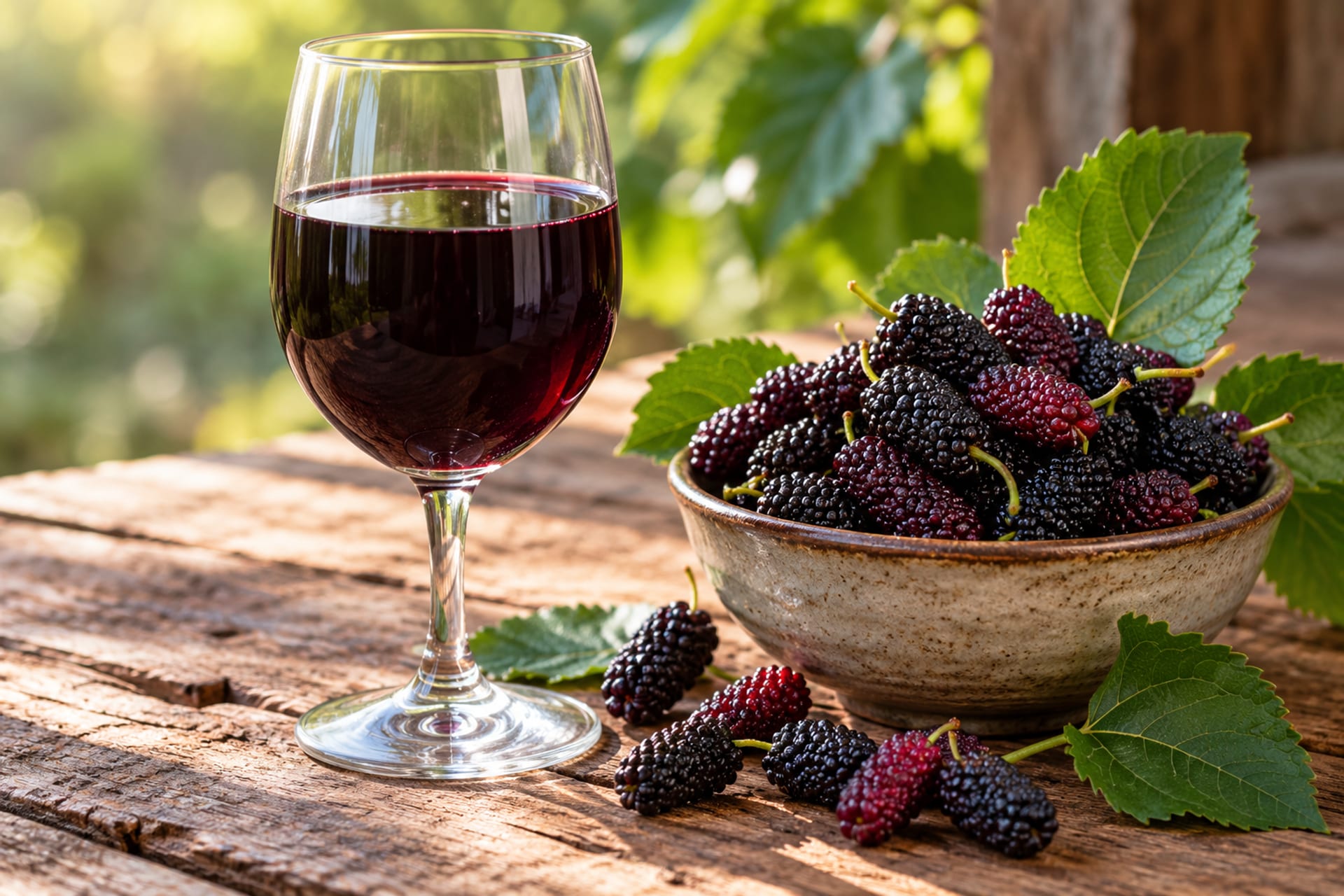
Keller starts the section on mulberries with the tree itself. The native American mulberry, Morus rubra, grows all over the United States and especially in the South. He warns that it should in no way be confused with the several hybrids of fruitless mulberry, or with the Chinese or Asian mulberry, whose fruit approaches two inches long.
Native tree or ornamental
Make sure the tree you pick from actually bears fruit, since the fruitless hybrids will not help you. Keller describes the native as a wonderful shade tree with fruit that is delicious raw, cooked into cobbler, or made into jelly or syrup.
Picking and handling
Keller notes the fruit can be messy, especially after birds have passed it through, so he suggests leaving the upper branches for them and harvesting what you can reach easily or with a step ladder. An average tree easily yields enough for several gallons of wine. Wash the berries and remove the stems before they go in the fermenter.
Protect the color
Like many dark berries, the wine’s color suffers in bright light. Keller’s advice is to use a dark glass fermentation vessel, or clear glass wrapped in brown butcher paper, and to store and age the bottles in a dark place.
Recipe card
Mulberry wine with raisins, 1 US gallon
- Makes
- About 5 bottles (750 ml)
- Time to drink
- 6 months to 1 year; better after 2 years
- Difficulty
- Intermediate
Ingredients
- 6 lb ripe mulberries, stems removed
- 1¾ lb granulated sugar
- 1 lb raisins, chopped or minced
- ¼ tsp pectic enzyme
- ½ tsp acid blend
- 6 pints water
- Yeast nutrient (dose on the package)
- Bordeaux wine yeast
Method
- Bring the water to a boil and dissolve the sugar in it, stirring until completely clear.
- Wash the mulberries, remove the stems and put them in the primary fermenter. Add the chopped or minced raisins.
- Pour the boiling sugar water over the fruit and let it cool to 75 to 80°F.
- Add the pectic enzyme, acid blend and yeast nutrient. Stir well, cover and set aside for 12 hours.
- Add the yeast, stir and cover again. Ferment 4 days on the pulp, punching down the cap and stirring twice a day.
- Strain through a nylon sieve, pressing lightly. Pour into a dark secondary vessel, or a clear one wrapped in brown paper, top up if needed and fit an airlock.
- Rack after two months and again two months later.
- Stabilize and set aside 2 to 3 weeks, then bottle. Store in a dark place and taste after six months to a year.
Quantities and method from Mulberry Wine (1) in Jack Keller’s Requested Recipes Collection (compiled 2020), which he labels his own recipe. Keller says it is a full-bodied wine that tastes better after two years.
Recipe 2: With Grape Concentrate
The second version swaps the raisins for a can of frozen grape juice concentrate. It is the same method with two changes in the card below: the thawed concentrate goes into the fermenter with the berries before the hot sugar water, and the water drops from 6 pints to 5, because the can adds liquid. If raisins are not in your pantry, this is the quicker one to assemble.
Recipe card
Mulberry wine with grape concentrate, 1 US gallon
- Makes
- About 5 bottles (750 ml)
- Time to drink
- 6 months to 1 year; better after 2 years
- Difficulty
- Intermediate
Ingredients
- 6 lb ripe mulberries, stems removed
- 1¾ lb granulated sugar
- One 11 oz can frozen Concord grape juice concentrate, thawed
- ¼ tsp pectic enzyme
- ½ tsp acid blend
- 5 pints water
- Yeast nutrient (dose on the package)
- Bordeaux wine yeast
Method
- Bring the water to a boil and dissolve the sugar in it, stirring until completely clear.
- Wash the mulberries, remove the stems and put them in the primary fermenter. Add the thawed can of grape concentrate.
- Pour the boiling sugar water over the fruit and let it cool to 75 to 80°F.
- Add the pectic enzyme, acid blend and yeast nutrient. Stir well, cover and set aside for 12 hours.
- Add the yeast, stir and cover again. Ferment 4 days on the pulp, punching down the cap and stirring twice a day.
- Strain through a nylon sieve, pressing lightly. Pour into a dark secondary vessel, or a clear one wrapped in brown paper, top up if needed and fit an airlock.
- Rack after two months and again two months later.
- Stabilize and set aside 2 to 3 weeks, then bottle. Store in a dark place and taste after six months to a year.
Quantities and method from Mulberry Wine (2) in Jack Keller’s Requested Recipes Collection (compiled 2020), which he labels his own recipe.
Why Mulberry Wine Needs Body
Keller’s verdict is blunt: mulberries by themselves make a poor wine unless you go all out and use 100% juice with no water. He says he has not tried that, so he cannot tell you how many pounds of berries it would take. The recipes above are his answer, and he says recipes like them require raisins or grape juice to give the wine body.
Thin wine and fleeting flavor
The question that started Keller’s section came from a reader whose mulberry wine had come out with little body or flavor. He adds that the flavor is somewhat fleeting. That is why the berries are only part of the story here, and why the raisins or concentrate are not optional extras.
Topping up with mulberry juice
To keep the flavor, Keller likes to top up with pure, strained mulberry juice. It tends to drag out the fermentation and usually means one more racking, but he says the added flavor is worth it. Our guide to how to rack wine covers the siphon method.
Do not use a thin batch in place of water
If you already have a thin mulberry wine, Keller would not use it instead of the water in a new batch, except for topping up, because the alcohol would end up too high and only a very high tolerance yeast would ferment it out. His suggestion for leftover thin wine is to use it for topping up and blend any remainder with a full-bodied grape wine.
Can You Make Mulberry Wine Without Yeast?
Fresh fruit carries wild yeast on its skin, so crushed mulberries left to themselves will often start fermenting. Both Keller recipes here use a Bordeaux wine yeast, though, and we do not give a yeast-free version because we have no tested quantities for one. If you want to try it, read our guide to making wine without yeast first. To compare packet strains, see the best wine yeasts.
Want another dark berry recipe? Try blackberry wine, and see our guide to making wine from fruit for the general method. Make and drink wine responsibly, and only if you are of legal drinking age.
What you need for mulberry wine
Items from the recipe cards that are easy to forget. You also need acid blend, a nylon straining bag or sieve, a dark 1 gallon jug with an airlock, and a Bordeaux wine yeast.
-
1Primary fermenter
FastRack 6.5 Gallon Fermenting Bucket
A food grade HDPE bucket with a lid drilled for an airlock grommet, per the listing, with room for the berries and their cap.
-
2Pectic enzyme
Home Brew Ohio Pectic Enzyme, 1 lb
Breaks down fruit pectin for easier straining and a clearer wine, according to the listing.
-
3Yeast nutrient
Both of Keller’s mulberry recipes call for yeast nutrient; follow the dose on the package.


