Kiwi Wine Recipe: A Dry White Wine From Green or Golden Kiwis
As an Amazon Associate we earn from qualifying purchases. How we choose products.
On this page
The short answer: a 1 gallon kiwi wine uses 3 to 4 pounds of peeled kiwifruit in a straining bag, 1¾ pounds of sugar dissolved in 7½ pints of boiling water, a teaspoon of acid blend, ½ teaspoon of pectic enzyme, ⅛ teaspoon of tannin, a teaspoon of yeast nutrient and a packet of Lalvin 71B or AC wine yeast. The fruit stays in the bag for seven days and is never squeezed. Rack at 1.015, rack twice more three months apart, and age six months in the bottle.
The recipe comes from Jack Keller’s Requested Recipes Collection (compiled 2020), written for a reader in Te Puke, New Zealand, and adapted from Terry Garey’s The Joy of Home Winemaking. Keller gives two versions, because the two common kinds of kiwi behave very differently in a wine. He describes green kiwi as an acidic fruit, and golden kiwi as much sweeter and less acidic, tasting like a cross between a banana and a melon. In his words, each makes an excellent white table wine. New to fruit wine? Start with our guide to making wine from fruit, then browse the full homemade wine recipes.
Green vs Golden Kiwi Wine
| Detail | Green kiwi wine | Golden kiwi wine |
|---|---|---|
| Fruit per gallon | 3 to 4 lb green kiwifruit | 3 to 4 lb golden kiwifruit |
| Sugar | 1¾ lb | 2 lb |
| Acid blend | 1 tsp | 1½ tsp |
| Starting gravity | Not given | 1.080 to 1.090 |
| Yeast | Lalvin AC or 71B-1122 | Lalvin D-47 or a Champagne yeast |
| Bag out | Day 7 | Day 7 |
| Into secondary | Below 1.015 | Below 1.015 |
| Bottle aging | 6 months | 6 months |
The pattern makes sense: the sweeter golden fruit gets more acid added to balance it, and a little more sugar.
Preparing Kiwifruit for Wine
Peel thinly, chop coarsely
Keller’s instruction is to peel the fruit thinly and chop it coarsely. The fuzzy skin stays out of the wine, and a thin peel keeps as much of the flesh as possible. Coarse chunks are enough: the boiling sugar water and the pectic enzyme will soften them, and you will crush them by hand in the bag.
Ripe, not mushy
Use kiwis that give slightly when pressed, the stage you would want for eating. Very hard fruit has less sugar and flavor; fruit that has gone soft and brown inside should be cut away. Weigh after peeling so you know how much flesh is actually going in.
The seeds
Kiwi flesh is full of tiny black seeds. The tied bag keeps them out of the fermenter, and Keller’s rule that the bag is never squeezed keeps seed fragments and fine pulp from being forced through the mesh into what should be a clear white wine. Keep the bag closed and let the juice come out on its own.
Recipe card
Green kiwi wine, 1 US gallon
- Makes
- About 5 bottles (750 ml)
- Time to drink
- 7 days on the fruit, about 6 months in bulk, 6 months in the bottle
- Difficulty
- Easy to intermediate
Ingredients
- 3 to 4 lb fresh green kiwifruit
- 1¾ lb finely granulated sugar
- 7½ pints water
- 1 tsp acid blend
- ½ tsp pectic enzyme
- ⅛ tsp tannin
- 1 tsp yeast nutrient
- 1 packet Lalvin AC or 71B-1122 (Narbonne) wine yeast
Method
- Bring the water to a boil with the sugar, stirring occasionally until it dissolves.
- Meanwhile, thinly peel and coarsely chop the fruit, put it in a nylon straining bag, tie it closed and place it in the primary.
- Crush the fruit in the bag with your hands.
- Add the acid blend, tannin and yeast nutrient to the primary, then pour the boiling sugar water over the fruit.
- Cover with a clean cloth and leave to cool.
- At room temperature, stir in the pectic enzyme, cover again and wait 12 hours.
- Add the activated yeast and cover.
- Stir daily, first lifting and dunking the bag several times. Do not squeeze the bag.
- After 7 days, lift out the bag and let it drip drain, without squeezing, for about an hour. Return the drained juice to the primary and discard the pulp.
- When the gravity drops below 1.015, rack into a secondary and fit an airlock.
- Rack after 3 months, top up and refit the airlock. Repeat after another 3 months.
- The wine should be clear and completely dry. To sweeten, stabilize, sweeten to taste, refit the airlock and wait 10 days.
- Bottle and age another 6 months. Serve lightly chilled.
Quantities and method from Kiwi Fruit Wine (1) in Jack Keller’s Requested Recipes Collection (compiled 2020), adapted by Keller from Terry Garey’s The Joy of Home Winemaking.
The Golden Kiwi Version
What changes
Keller’s second card is for golden kiwifruit and follows the same method with three changes: 2 pounds of sugar instead of 1¾, 1½ teaspoons of acid blend instead of 1, and Lalvin D-47 or any Champagne yeast in place of 71B. It also adds a check the green card leaves out. Once the sugar water has cooled to room temperature, take a reading and make sure the gravity sits between 1.080 and 1.090, correcting it if needed, before the pectic enzyme goes in.
How strong golden kiwi wine will be
With a gravity target, the arithmetic is simple. Using the potential alcohol formula, (starting gravity minus 1) × 131.25:
| Starting gravity | Potential alcohol if it ferments to 1.000 |
|---|---|
| 1.080 | About 10.5% |
| 1.085 | About 11.2% |
| 1.090 | About 11.8% |
Keller wants the wine completely dry at the end, so it may finish slightly below 1.000 and a touch stronger than the table. Record your actual readings and check them with the wine ABV calculator. To correct a low starting reading, the sugar calculator gives the amount of sugar to add.
Green kiwi with a gravity check
The green card gives no target, but nothing stops you measuring it. Taking a reading before the yeast goes in tells you what you are making and gives you the starting number for an ABV calculation later. Our hydrometer guide shows how.
Why the Bag Is Never Squeezed
Lift and dunk instead
Keller’s daily routine is to lift the bag and dunk it several times before stirring, and he writes the warning in capitals: do NOT squeeze the bag. Dunking moves fresh liquid through the fruit and lets juice out gently, without the pressure that pushes pulp through the mesh.
Drip drain on day seven
On day seven the bag comes out and hangs over the primary or a bowl to drip for about an hour, again without squeezing. It feels wasteful to leave juice in the bag. It is the price of a clear white wine. If a haze does appear later, our guide on how to clear wine covers the options, and pectic enzyme added at the start is your best protection against a pectin haze.
Aging, Sweetening and Serving
Six months in bulk, six in the bottle
Counting the two three month rackings, the wine spends about six months in the jug before bottling, and Keller sets aside another six months of bottle age after that. Our racking guide covers the two rackings, including topping up so the wine is not left under a big headspace.
Dry by default
Both recipes ferment to a completely dry wine. Keller’s note is that if it is too dry for your taste you should stabilize it, sweeten it to your liking, refit the airlock and wait 10 days before bottling, so you can see that nothing restarts. Our guide to backsweetening wine walks through the stabilizers and the amounts.
Serve it lightly chilled
Keller ends both cards the same way: serve lightly chilled. Treat it like any light white wine. Make and drink wine responsibly, and only if you are of legal drinking age.
What you need for kiwi wine
The additives and yeasts for both cards. You also need a primary fermenter, a 1 gallon jug with an airlock, a hydrometer, a siphon and bottles.
-
1Straining bag
Fine 250 micron mesh keeps kiwi seeds in the bag while you lift and dunk it.
-
2Pectic enzyme
Home Brew Ohio Pectic Enzyme, 1 lb
Half a teaspoon per gallon, added once the must has cooled, as both cards say.
-
3Tannin
North Mountain Supply Wine Tannin, 2 oz
The recipe needs only ⅛ teaspoon per gallon, so a small jar lasts many batches.
-
5Yeast nutrient
North Mountain Supply Yeast Nutrient, 3.5 oz
One teaspoon per gallon in both recipes.
-
6Yeast for green kiwi
Lalvin 71B Wine Yeast, 10 pack
Keller’s first choice for the green card, listed as 71B-1122 (Narbonne).
-
7Yeast for golden kiwi
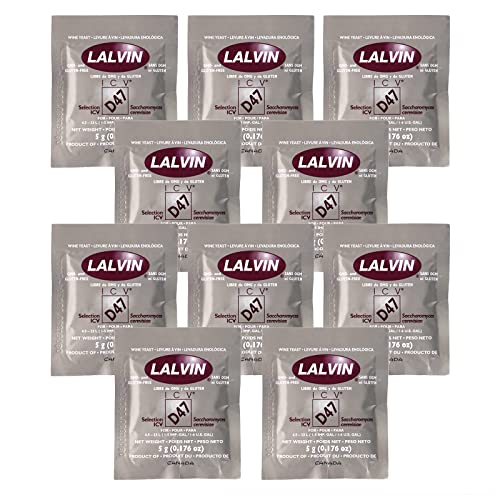
Lalvin ICV-D47 Wine Yeast, 10 pack
The strain Keller names for golden kiwi wine; any Champagne yeast is his alternative.